Advertisements
Advertisements
Question
One of the angles of a triangle is 65°. If the difference of the other two angles is 45°, then the two angles are
Options
85°, 40°
70°, 25°
80°, 35°
80°, 135°
Advertisements
Solution
One of the angles of a triangle is 65°. If the difference of the other two angles is 45°, then the two angles are 80°, 35°
APPEARS IN
RELATED QUESTIONS
Can a triangle have All angles equal to 60°? Justify your answer in case.
Is the following statement true and false :
If one angle of a triangle is obtuse, then it cannot be a right angled triangle.
Is the following statement true and false :
An exterior angle of a triangle is equal to the sum of the two interior opposite angles.
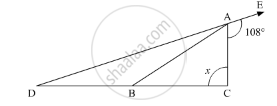
In the given figure, AB divides ∠DAC in the ratio 1 : 3 and AB = DB. Determine the value of x.
In a triangle PQR, ∠P = 60° and ∠Q = ∠R, find ∠R.
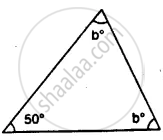
Find the unknown marked angles in the given figure:
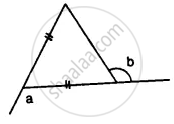
In the given figure, express a in terms of b.
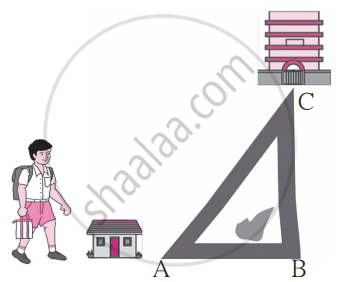
As shown in the figure, Avinash is standing near his house. He can choose from two roads to go to school. Which way is shorter? Explain why.
In ΔABC, name the 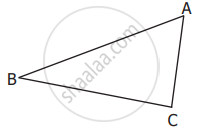
a) Three sides: _________, __________, __________
b) Three Angles: _________, __________, __________
c) Three Vertices: _________, __________, __________
Can we have two acute angles whose sum is a straight angle? Why or why not?
