Advertisements
Advertisements
Question
ABC is an isosceles triangle with AB = AC and D is a point on BC such that AD ⊥ BC (Figure). To prove that ∠BAD = ∠CAD, a student proceeded as follows:
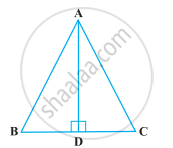
In ∆ABD and ∆ACD,
AB = AC (Given)
∠B = ∠C (Because AB = AC)
and ∠ADB = ∠ADC
Therefore, ∆ABD ≅ ∆ACD (AAS)
So, ∠BAD = ∠CAD (CPCT)
What is the defect in the above arguments?
[Hint: Recall how ∠B = ∠C is proved when AB = AC].
Advertisements
Solution
In ∆ABC, AB = AC
⇒ ∠ACB = ∠ABC ...[Angles opposite to the equal sides are equal]
In ∆ABD and ∆ACD,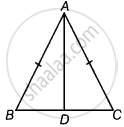
AB = AC ...[Given]
∠ABD = ∠ACD ...[Proved above]
∠ADB = ∠ADC ...[Each 90°]
∴ ∆ABD ≅ ∆ACD ...[By AAS]
So, ∠BAD = ∠CAD ...[By CPCT]
So, the defect in the given argument is that firstly prove ∠ABD = ∠ACD
Hence, ∠ABD = ∠ACD is defect.
APPEARS IN
RELATED QUESTIONS
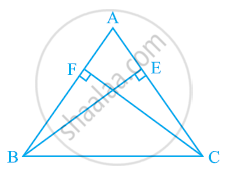
ABC is a triangle in which altitudes BE and CF to sides AC and AB are equal (see the given figure). Show that
- ΔABE ≅ ΔACF
- AB = AC, i.e., ABC is an isosceles triangle.
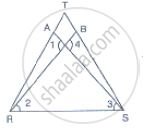
In Fig. 10.40, it is given that RT = TS, ∠1 = 2∠2 and ∠4 = 2∠3. Prove that ΔRBT ≅ ΔSAT
Prove that the medians of an equilateral triangle are equal.
Two lines AB and CD intersect at O such that BC is equal and parallel to AD. Prove that the lines AB and CD bisect at O.
Angles A, B, C of a triangle ABC are equal to each other. Prove that ΔABC is equilateral.
In a ΔPQR, if PQ = QR and L, M and N are the mid-points of the sides PQ, QR and RP
respectively. Prove that LN = MN.
Fill the blank in the following so that the following statement is true.
In an isosceles triangle ABC with AB = AC, if BD and CE are its altitudes, then BD is …… CE.
If the angles of a triangle are in the ratio 2 : 1 : 3, then find the measure of smallest angle.
If the angles A, B and C of ΔABC satisfy the relation B − A = C − B, then find the measure of ∠B.
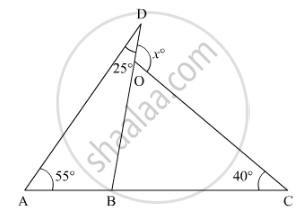
In the given figure, the value of x is ______.
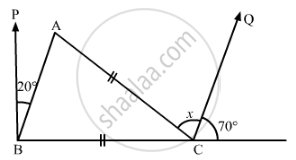
In the given figure, if BP || CQ and AC = BC, then the measure of x is
The base BC of triangle ABC is produced both ways and the measure of exterior angles formed are 94° and 126°. Then, ∠BAC =
In a ΔABC, ∠A = 50° and BC is produced to a point D. If the bisectors of ∠ABC and ∠ACDmeet at E, then ∠E =
Two sides of a triangle are of lengths 5 cm and 1.5 cm. The length of the third side of the triangle cannot be ______.
If ∆PQR ≅ ∆EDF, then is it true to say that PR = EF? Give reason for your answer
Bisectors of the angles B and C of an isosceles triangle ABC with AB = AC intersect each other at O. Show that external angle adjacent to ∠ABC is equal to ∠BOC
Find all the angles of an equilateral triangle.
Show that in a quadrilateral ABCD, AB + BC + CD + DA > AC + BD
In a triangle ABC, D is the mid-point of side AC such that BD = `1/2` AC. Show that ∠ABC is a right angle.
