Advertisements
Advertisements
Question
ABC is a triangle. The bisector of the exterior angle at B and the bisector of ∠C intersect each other at D. Prove that ∠D = \[\frac{1}{2}\] ∠A.
Advertisements
Solution
In the given ΔABC, the bisectors of ext,∠B and ∠Cntersect at D
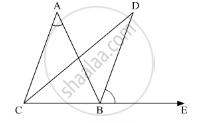
We need to prove: `∠D = 1/2 ∠A`
Now, using the exterior angle theorem,
\[\angle ABE = \angle BAC + \angle ACB\] .….(1)
\[As \angle \text {ABE and } \angle \text { ACB are bisected }\]
\[\angle DCB = \frac{1}{2}\angle ACB\]
Also,
\[\angle DBA = \frac{1}{2}\angle ABE\]
Further, applying angle sum property of the triangle
In ΔDCB
\[\angle CDB + \angle DCB + \angle CBD = 180^\circ\]
\[ \Rightarrow \angle CDB + \frac{1}{2}\angle ACB + \left( \angle DBA + \angle ABC \right) = 180^\circ\]
\[\angle CDB + \frac{1}{2}\angle ACB + \left( \frac{1}{2}\angle ABE + \angle ABC \right) = 180^\circ . . . . . \left( 2 \right)\]
Also, CBE is a straight line, So, using linear pair property
\[\Rightarrow \angle ABC + \angle ABE = 180^\circ\]
\[ \Rightarrow \angle ABC + \frac{1}{2}\angle ABE + \frac{1}{2}\angle ABE = 180^\circ \]
\[ \Rightarrow \angle ABC + \frac{1}{2}\angle ABE = 180^\circ - \frac{1}{2}\angle ABE . . . . . \left( 3 \right)\]
So, using (3) in (2)
\[\angle CDB + \frac{1}{2}\angle ACB + \left( 180^\circ - \frac{1}{2}\angle ABE \right) = 180^\circ \]
\[ \Rightarrow \angle CDB + \frac{1}{2}\angle ACB - \frac{1}{2}\angle ABE = 0\]
\[ \Rightarrow \angle CDB = \frac{1}{2}\left( \angle ABE - \angle ACB \right)\]
\[ \Rightarrow \angle CDB = \frac{1}{2}\angle CAB\]
\[ \Rightarrow \angle D = \frac{1}{2}\angle A\]
Hence proved.
APPEARS IN
RELATED QUESTIONS
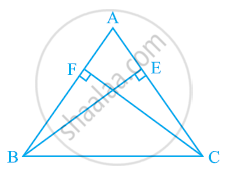
ABC is a triangle in which altitudes BE and CF to sides AC and AB are equal (see the given figure). Show that
- ΔABE ≅ ΔACF
- AB = AC, i.e., ABC is an isosceles triangle.
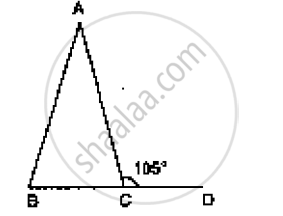
In Figure AB = AC and ∠ACD =105°, find ∠BAC.
Prove that the medians of an equilateral triangle are equal.
Find the measure of each exterior angle of an equilateral triangle.
Two lines AB and CD intersect at O such that BC is equal and parallel to AD. Prove that the lines AB and CD bisect at O.
Fill the blank in the following so that the following statement is true.
In an equilateral triangle all angles are .....
Fill the blank in the following so that the following statement is true.
In a ΔABC if ∠A = ∠C , then AB = ......
Is it possible to draw a triangle with sides of length 2 cm, 3 cm and 7 cm?
Which of the following statements are true (T) and which are false (F)?
Sum of any two sides of a triangle is greater than twice the median drawn to the third side.
Which of the following statements are true (T) and which are false (F)?
Sum of any two sides of a triangle is greater than the third side.
Which of the following statements are true (T) and which are false (F)?
Difference of any two sides of a triangle is equal to the third side.
Which of the following statements are true (T) and which are false (F)?
If two angles of a triangle are unequal, then the greater angle has the larger side opposite to it.
Fill in the blank to make the following statement true.
In a right triangle the hypotenuse is the .... side.
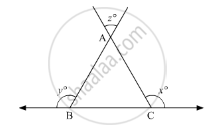
In the given figure, x + y =
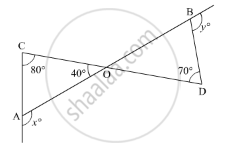
In the given figure, what is z in terms of x and y?
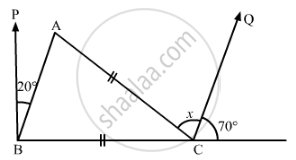
In the given figure, if BP || CQ and AC = BC, then the measure of x is
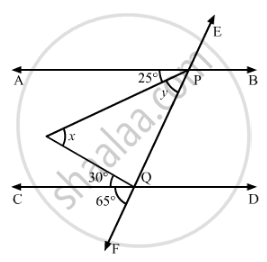
In the given figure, AB and CD are parallel lines and transversal EF intersects them at Pand Q respectively. If ∠APR = 25°, ∠RQC = 30° and ∠CQF = 65°, then
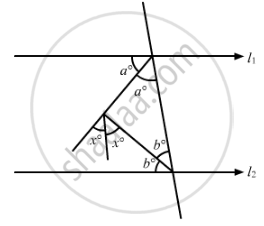
In the given figure, if l1 || l2, the value of x is
In ∆ABC, AB = AC and ∠B = 50°. Then ∠C is equal to ______.
In ∆PQR, if ∠R > ∠Q, then ______.
