Advertisements
Advertisements
Question
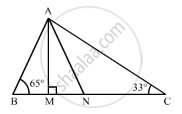
In the given figure, AM ⊥ BC and AN is the bisector of ∠A. If ∠B = 65° and ∠C = 33°, find ∠MAN.
Advertisements
Solution
In the given ΔABC, AM⊥BC, ANis the bisector of ∠A, ∠B = 65 and ∠C = 33
We need to find ∠MAN
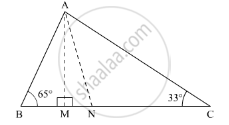
Now, using the angle sum property of the triangle
In ΔAMC, we get,
∠MAC + ∠AMC + ∠ACM = 180°
∠MAC + 90° + 33° = 180°
∠MAC + 123° = 180
∠MAC= 180° - 123°
∠MAC = 57°…….(1)
Similarly,
In ΔABM, we get,
∠ABM + ∠AMB+ ∠BAM = 180°
∠BAM + 90°+ 65° = 180°
∠AM + 155° = 180°
∠BAM = 180° - 155°
∠BAM …..(2)
So, adding (1) and (2)
∠BAM + ∠MAC = 25° + 57°
∠BAM + ∠MAC = 82°
Now, since AN is the bisector of ∠A
∠BAN = ∠NAC
Thus,
∠BAN + ∠NAC = 82°
2∠BAN =82°
` ∠BAN = (82°)/2`
= 41
Now,
∠MAN = ∠BAN - ∠BAM
= 41 - 25
= 16
Therefore, ∠MAN = 16.
APPEARS IN
RELATED QUESTIONS
Can a triangle have All angles equal to 60°? Justify your answer in case.
If the bisector of the exterior vertical angle of a triangle be parallel to the base. Show that the triangle is isosce
Is the following statement true and false :
A triangle can have two obtuse angles.
In a triangle PQR, ∠P = 60° and ∠Q = ∠R, find ∠R.
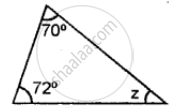
In the following, find the marked unknown angle:
In ∆ABC, C = 56° C = 56° ∠B = ∠C and ∠A = 100° ; find ∠B.
Classify the following triangle according to sides:

The angles of a triangle are in the ratio 2 : 3 : 4. Then the angles are
Q is a point on the side SR of a ∆PSR such that PQ = PR. Prove that PS > PQ.
The sides of a triangle must always be connected so that:
