Advertisements
Advertisements
Question
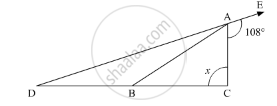
In the given figure, AB divides ∠DAC in the ratio 1 : 3 and AB = DB. Determine the value of x.
Advertisements
Solution
In the given figure,∠EAC = 108° and DB = AB

Since,DB = AB and angles opposite to equal sides are equal. We get,
\[\angle BDA = \angle BAD . . . . . \left( 1 \right)\]
Also, EAD is a straight line. So, using the property, “the angles forming a linear pair are supplementary”, we get,
∠EAC + ∠DAC =- 180°
∠DAC + 180° = 180°
∠DAC = 180° - 108°
∠DAC = 72°
Further, it is given AB divides ∠DAC in the ratio 1 : 3.
So, let
\[\angle DAB = y, \angle BAC = 3y\]
Thus,
\[y + 3y = \angle DAC\]
\[ \Rightarrow 4y = 72^\circ \]
\[ \Rightarrow y = \frac{72^\circ}{4}\]
\[ \Rightarrow y = 18^\circ\]
Hence.
\[\angle DAB = 18^\circ, \angle BAC = 3 \times 18^\circ = 54^\circ\]
Using (1)
∠BDA = ∠DAB
∠BDA = 18°
Now, in ΔABC , using the property, “exterior angle of a triangle is equal to the sum of its two opposite interior angles”, we get,
\[\angle EAC = \angle ADC + x\]
\[ \Rightarrow 108^\circ = 18^\circ + x\]
\[ \Rightarrow x = 90^\circ\]
APPEARS IN
RELATED QUESTIONS
If the bisectors of the base angles of a triangle enclose an angle of 135°, prove that the triangle is a right triangle.
Is the following statement true and false :
A triangle can have at most one obtuse angles.
State exterior angle theorem.
If two acute angles of a right triangle are equal, then each acute is equal to
If the angles of a triangle are equal, find its angles.
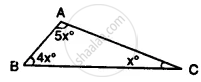
Find the value of the angle in the given figure:
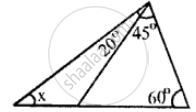
In the following, find the marked unknown angle:
Classify the following triangle according to sides:

Q is a point on the side SR of a ∆PSR such that PQ = PR. Prove that PS > PQ.
What is common in the following figure?
 |
 |
| (i) | (ii) |
Is figure (i) that of triangle? if not, why?
