Advertisements
Advertisements
Question
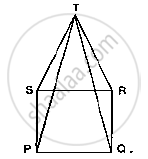
In Fig. 10.23, PQRS is a square and SRT is an equilateral triangle. Prove that
(i) PT = QT (ii) ∠TQR = 15°
Advertisements
Solution
Given that PQRS is a square and SRT is an equilateral triangle. And given to prove that

PT = QT and ∠ TQR =15 °
Now , PQRS is a square
⇒ PQ =QR=RS=SP ....................... (1)
And also, SRT is an equilateral triangle.
⇒ SR = RT=TS .............................(2)
And ∠TSR = ∠SRT= ∠RTS = 60°
From (1) and (2)
PQ=QR=SP=SR=RT=TS ...........................(3)
And also,
∠TSR=∠TSR+∠RSP= 60° +90° +150°
∠TRQ=∠TRS+∠SRQ=60°+90°+150°
⇒ ∠TSR=∠TRQ=150° ............................(4)
Now, in Δ TSR and Δ TRQ
TS=TR [from (3)]Δ
∠TSP = ∠TRQ [from (4)]
SP=RQ [from (3)]
So, by SAS ccongruence criterion we have
Δ TSR ≅ Δ TRQ
⇒ PT=QT [corresponding parts of congruent triangles are equal ]
Consider Δ TQR,
QR= TR [from (3)]
⇒ Δ TQR is a isosceles triangle
∠QTR=∠TQR [angles opposite to equal sides]
Now,
Sum of angles in a traingle is qual to 180°
⇒ ∠ QTR+∠TQR + ∠TRQ =180°
⇒ 2∠TQR+150°=180 [from (4)]
⇒ 2∠TQR = 180° -150°
⇒ 2 ∠TQR = 30° ∠TQR=15 °
∴ Hence Proved
APPEARS IN
RELATED QUESTIONS
In an isosceles triangle ABC, with AB = AC, the bisectors of ∠B and ∠C intersect each other at O. Join A to O. Show that:
- OB = OC
- AO bisects ∠A
ΔABC is an isosceles triangle in which AB = AC. Side BA is produced to D such that AD = AB (see the given figure). Show that ∠BCD is a right angle.

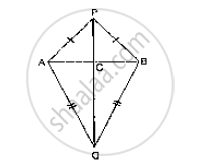
AB is a line seg P and Q are points on opposite sides of AB such that each of them is equidistant from the points A and B (See Fig. 10.26). Show that the line PQ is perpendicular bisector of AB.
In a ΔABC, if ∠A=l20° and AB = AC. Find ∠B and ∠C.
ABC is a triangle in which ∠B = 2 ∠C. D is a point on BC such that AD bisects ∠BAC and AB = CD.
Prove that ∠BAC = 72°.
Fill the blank in the following so that the following statement is true.
If altitudes CE and BF of a triangle ABC are equal, then AB = ....
Fill in the blank to make the following statement true.
If two angles of a triangle are unequal, then the smaller angle has the........ side opposite to it.
Fill in the blank to make the following statement true.
If two sides of a triangle are unequal, then the larger side has .... angle opposite to it.
ABC is a triangle. The bisector of the exterior angle at B and the bisector of ∠C intersect each other at D. Prove that ∠D = \[\frac{1}{2}\] ∠A.
If the angles of a triangle are in the ratio 2 : 1 : 3, then find the measure of smallest angle.
In ΔABC, if ∠A = 100°, AD bisects ∠A and AD ⊥ BC. Then, ∠B =
Line segments AB and CD intersect at O such that AC || DB. If ∠CAB = 45° and ∠CDB = 55°, then ∠BOD =
If the measures of angles of a triangle are in the ratio of 3 : 4 : 5, what is the measure of the smallest angle of the triangle?
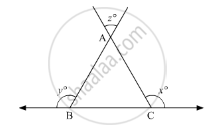
In the given figure, what is z in terms of x and y?
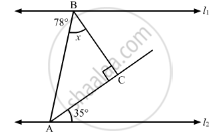
In the given figure, for which value of x is l1 || l2?
The angles of a right angled triangle are
In ∆PQR, if ∠R > ∠Q, then ______.
CDE is an equilateral triangle formed on a side CD of a square ABCD (Figure). Show that ∆ADE ≅ ∆BCE.

Show that in a quadrilateral ABCD, AB + BC + CD + DA < 2(BD + AC)
