Advertisements
Advertisements
प्रश्न
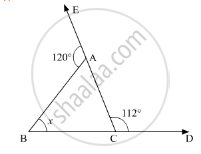
Compute the value of x in the following figure:
Advertisements
उत्तर
In the given problem, we need to find the value of x
In the given ΔABC, ∠ACD = 112° and ∠BAE = 120°
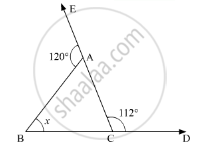
Now, BCD is a straight line. So, using the property, “the angles forming a linear pair are supplementary”, we get,
∠ABC + ∠ACD = 180°
∠ABC + 112 = 180°
∠ACB = 180° - 112°
∠ACB = 68°
Similarly, EAC is a straight line. So, we get,
∠BAE + ∠BAC = 180°
120° + ∠BAC = 180°
∠BAC = 180° - 120°
∠BAC = 60°
Further, using the angle sum property of a triangle,
In ΔABC
∠ACB + ∠BAC + ∠ABC = 180°
68° + 60° + ∠ABC = 180°
128° + ∠ABC = 180° -128°
∠ABC = 52°
Therefore, x = 52°
APPEARS IN
संबंधित प्रश्न
The angles of a triangle are arranged in ascending order of magnitude. If the difference
between two consecutive angles is 10°, find the three angles.
ABC is a triangle in which ∠A — 72°, the internal bisectors of angles B and C meet in O.
Find the magnitude of ∠BOC.
Can a triangle have two right angles? Justify your answer in case.
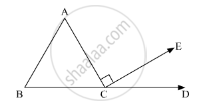
In the given figure, AC ⊥ CE and ∠A : ∠B : ∠C = 3 : 2 : 1, find the value of ∠ECD.
Is the following statement true and false :
An exterior angle of a triangle is greater than the opposite interior angles.
Side BC of a triangle ABC has been produced to a point D such that ∠ACD = 120°. If ∠B = \[\frac{1}{2}\]∠A is equal to
If two sides of a triangle are 5 cm and 1.5 cm, the length of its third side cannot be ______.
The length of the three segments is given for constructing a triangle. Say whether a triangle with these sides can be drawn. Give the reason for your answer.
15 cm, 20 cm, 25 cm
The angles of the triangle are 3x – 40, x + 20 and 2x – 10 then the value of x is
What is the sum of the measures of the interior angles of any triangle, △ABC?
