Advertisements
Advertisements
प्रश्न
In the given figure, the sides BC, CA and AB of a Δ ABC have been produced to D, E and F respectively. If ∠ACD = 105° and ∠EAF = 45°, find all the angles of the Δ ABC.
Advertisements
उत्तर
In the given ΔABC, ∠ACD = 105°and ∠EAF = 45°. We need to find ∠ABC, ∠ACB, and ∠BAC.

Here, ∠EAF and ∠BAC are vertically opposite angles. So, using the property, “vertically opposite angles are equal”, we get,
∠EAF = ∠BAC
∠BAC = 45°
Further, BCD is a straight line. So, using linear pair property, we get,
∠ACB + ∠ACD = 180°
∠ACB + 105° = 180°
∠ACB = 180° - 105°
∠ACB = 75°
Now, in ΔABC, using “the angle sum property”, we get,
∠ABC + ∠ACB + ∠BAC = 180°
45° + 75° + ∠ABC = 180°
∠BAC = 180°
∠BAC = 180° - 120°
∠BAC = 60
Therefore,∠ACB = 75° , ∠BAC = 45°,∠ABC = 60°.
APPEARS IN
संबंधित प्रश्न
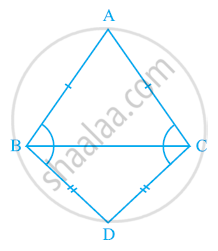
ABC and DBC are two isosceles triangles on the same base BC (see the given figure). Show that ∠ABD = ∠ACD.
Show that the angles of an equilateral triangle are 60° each.
Find the measure of each exterior angle of an equilateral triangle.
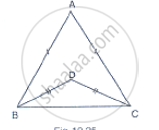
In figure, AB = AC and DB = DC, find the ratio ∠ABD : ∠ACD
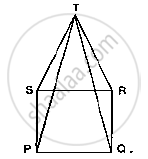
In Fig. 10.23, PQRS is a square and SRT is an equilateral triangle. Prove that
(i) PT = QT (ii) ∠TQR = 15°
Prove that the medians of an equilateral triangle are equal.
If the base of an isosceles triangle is produced on both sides, prove that the exterior angles so formed are equal to each other.
Fill the blank in the following so that the following statement is true.
Angle opposite to equal sides of a triangle are .....
Fill the blank in the following so that the following statement is true.
If altitudes CE and BF of a triangle ABC are equal, then AB = ....
In a ΔABC, if ∠B = ∠C = 45°, which is the longest side?
ABC is a triangle. The bisector of the exterior angle at B and the bisector of ∠C intersect each other at D. Prove that ∠D = \[\frac{1}{2}\] ∠A.
In a triangle ABC, if AB = AC and AB is produced to D such that BD = BC, find ∠ACD: ∠ADC.
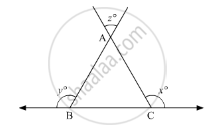
In the given figure, x + y =
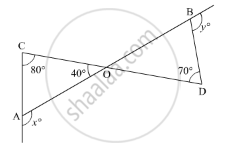
In the given figure, what is z in terms of x and y?
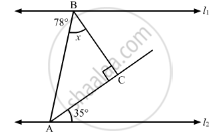
In the given figure, for which value of x is l1 || l2?
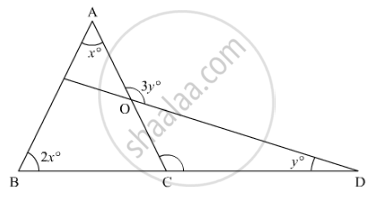
In the given figure, what is y in terms of x?
The angles of a right angled triangle are
Bisectors of the angles B and C of an isosceles triangle ABC with AB = AC intersect each other at O. Show that external angle adjacent to ∠ABC is equal to ∠BOC
Show that in a quadrilateral ABCD, AB + BC + CD + DA < 2(BD + AC)
