Advertisements
Advertisements
प्रश्न
The exterior angles, obtained on producing the base of a triangle both way are 104° and 136°. Find all the angles of the triangle.
Advertisements
उत्तर
In the given problem, the exterior angles obtained on producing the base of a triangle both ways are 104° and 136°. So, let us draw ΔABC and extend the base BC, such that:
∠ACD = 104°
∠ABE = 136°
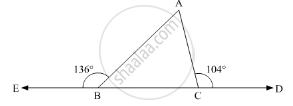
Here, we need to find all the three angles of the triangle.
Now, since BCD is a straight line, using the property, “angles forming a linear pair are supplementary”, we get
∠ACB + ∠ADC = 180°
∠ACB + 104° = 180°
∠ACB = 180° – 104°
∠ACB = 76°
Similarly, EBC is a straight line, so we get,
∠ABC + ∠ABE = 180°
∠ABC + 136° = 180°
∠ABC = 44
Further, using angle sum property in ΔABC
∠ABC + ∠ACB + ∠BAC = 180°
44 + 76 + ∠BAC = 180°
∠ABC = 180° – 120°
∠ABC = 60°
Therefore, ∠ACB = 76°, ∠BAC = 60°, ∠ABC = 44°.
APPEARS IN
संबंधित प्रश्न
The bisectors of base angles of a triangle cannot enclose a right angle in any case.
Is the following statement true and false :
A triangle can have two obtuse angles.
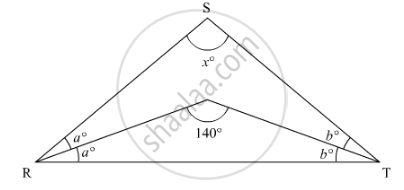
In ΔRST (See figure), what is the value of x?
State, if the triangle is possible with the following angles :
125°, 40°, and 15°
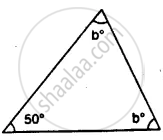
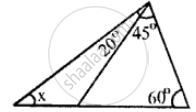
Find the unknown marked angles in the given figure:
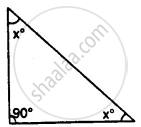
Find the unknown marked angles in the given figure:
One angle of a triangle is 61° and the other two angles are in the ratio `1 1/2: 1 1/3`. Find these angles.
In the following, find the marked unknown angle:
Can 30°, 60° and 90° be the angles of a triangle?
What is the sum of the measures of the interior angles of any triangle, △ABC?
