Advertisements
Advertisements
प्रश्न
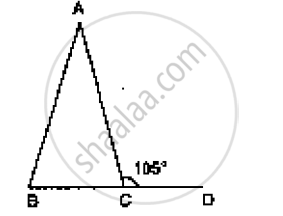
In Figure AB = AC and ∠ACD =105°, find ∠BAC.
Advertisements
उत्तर
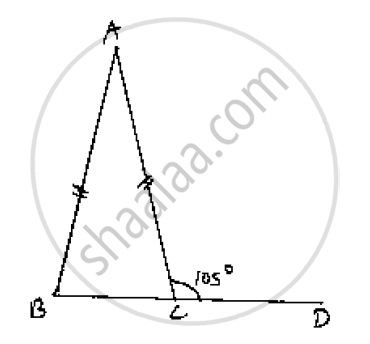
Consider the given figure
We have,
AB = AC and ∠ACD =105^@
Since,
∠BCD = 180° = Straight angle
∠BCA + ∠ACD = 180°
∠BCA +105° = 180°
∠BCA = 180° -105° ⇒ ∠BCA = 75° .......1
And also,
ΔABC is an isosceles triangle [∵AB = AC]
⇒ ∠ABC = ∠ACB
From (1), we have [Angles opposite to equal sides are equal]
∠ACB = 75° ⇒∠ABC = ∠ACB = 75°
And also,
Sum of interior angles of a triangle = 180°
⇒∠ABC = ∠BCA + ∠CAB = 180°
⇒ 75° + 75° + ÐCAB = 180°
⇒ 150° +∠BAC = 180°⇒ ∠BAC = 180° -150° = 30°
∠BAC=30°
APPEARS IN
संबंधित प्रश्न
Show that the angles of an equilateral triangle are 60° each.
Find the measure of each exterior angle of an equilateral triangle.
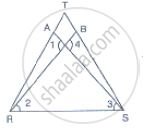
In Fig. 10.40, it is given that RT = TS, ∠1 = 2∠2 and ∠4 = 2∠3. Prove that ΔRBT ≅ ΔSAT
In a ΔABC, if AB = AC and ∠B = 70°, find ∠A.
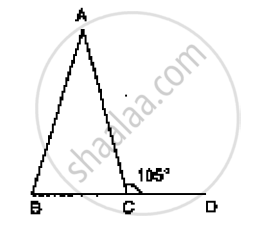
In Figure 10.24, AB = AC and ∠ACD =105°, find ∠BAC.
Which of the following statements are true (T) and which are false (F):
Angles opposite to equal sides of a triangle are equal
Fill the blank in the following so that the following statement is true.
Sides opposite to equal angles of a triangle are ......
Fill in the blank to make the following statement true.
In a right triangle the hypotenuse is the .... side.
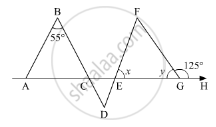
In the given figure, if AB || DE and BD || FG such that ∠FGH = 125° and ∠B = 55°, find x and y.
In ΔABC, if ∠A = 100°, AD bisects ∠A and AD ⊥ BC. Then, ∠B =
In a ΔABC, if ∠A = 60°, ∠B = 80° and the bisectors of ∠B and ∠C meet at O, then ∠BOC =
In the given figure, what is z in terms of x and y?
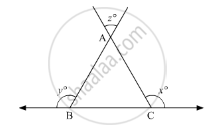
The base BC of triangle ABC is produced both ways and the measure of exterior angles formed are 94° and 126°. Then, ∠BAC =
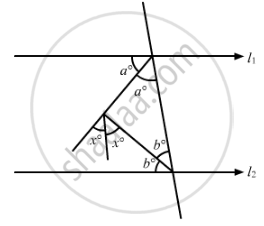
In the given figure, if l1 || l2, the value of x is
D is a point on the side BC of a ∆ABC such that AD bisects ∠BAC. Then ______.
Two sides of a triangle are of lengths 5 cm and 1.5 cm. The length of the third side of the triangle cannot be ______.
In ∆PQR, if ∠R > ∠Q, then ______.
Is it possible to construct a triangle with lengths of its sides as 8 cm, 7 cm and 4 cm? Give reason for your answer.
In the following figure, D and E are points on side BC of a ∆ABC such that BD = CE and AD = AE. Show that ∆ABD ≅ ∆ACE.

Show that in a quadrilateral ABCD, AB + BC + CD + DA < 2(BD + AC)
