Advertisements
Advertisements
प्रश्न
O is a point in the interior of a square ABCD such that OAB is an equilateral triangle. Show that ∆OCD is an isosceles triangle.
Advertisements
उत्तर
Given: O is a point in the interior of a square ABCD such that ΔOAB is an equilateral triangle.
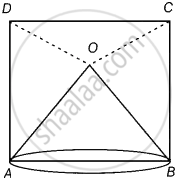
Construction: Join OC and OD.
To show: ΔOCD is an isosceles triangle.
Proof: Since, AOB is an equilateral triangle.
∴ ∠OAB = ∠OBA = 60° ...(i)
Also, ∠DAB = ∠CBA = 90° ...(ii) [Each angle of a square is 90°] [∵ ABCD is a square]
On subtracting equation (i) from equation (ii), we get
∠DAB – ∠OAB = ∠CBA – ∠OBA = 90° – 60°
i.e. ∠DAO = ∠CBO = 30°
In ΔAOD and ΔBOC,
AO = BO ...[Given] [All the side of an equilateral triangle are equal]
∠DAO = ∠CBO ...[Proved above]
And AD = BC ...[Sides of a square are equal]
∴ ΔAOD ≅ ΔBOC ...[By SAS congruence rule]
Hence, OD = OC ...[By CPCT]
In ΔCOD,
OC = OD
Hence, ΔCOD is an isosceles triangle.
Hence proved.
APPEARS IN
संबंधित प्रश्न
ABC is a triangle in which ∠A — 72°, the internal bisectors of angles B and C meet in O.
Find the magnitude of ∠BOC.
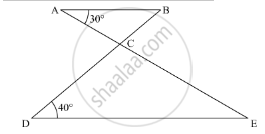
In the given figure, AB || DE. Find ∠ACD.
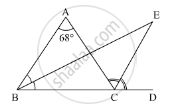
In the given figure, side BC of ΔABC is produced to point D such that bisectors of ∠ABC and ∠ACD meet at a point E. If ∠BAC = 68°, find ∠BEC.
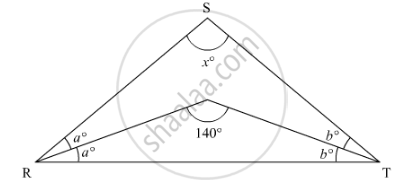
In ΔRST (See figure), what is the value of x?
The angle of a vertex of an isosceles triangle is 100°. Find its base angles.
The length of the three segments is given for constructing a triangle. Say whether a triangle with these sides can be drawn. Give the reason for your answer.
12 cm, 12 cm, 16 cm
Match the following:
| Column A | Column B |
| (i) No sides are equal | Isosceles triangle |
| (ii) One right angle | Scalene triangle |
| (iii) One obtuse angle | Right angled triangle |
| (iv) Two sides of equal length | Equilateral triangle |
| (v) All sides are equal | Obtuse angled triangle |
In the following figure, AD is the bisector of ∠BAC. Prove that AB > BD.
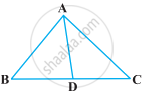
AB and CD are the smallest and largest sides of a quadrilateral ABCD. Out of ∠B and ∠D decide which is greater.
Can we have two acute angles whose sum is a reflex angle? Why or why not?
