Advertisements
Advertisements
प्रश्न
ABC and DBC are two triangles on the same base BC such that A and D lie on the opposite sides of BC, AB = AC and DB = DC. Show that AD is the perpendicular bisector of BC.
Advertisements
उत्तर
Given in the question, ABC and DBC are two triangles on the same base BC such that A and D lie on the opposite sides of BC, AB = AC and DB = DC.
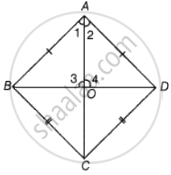
To proof that AD is the perpendicular bisector of BC that is OB = OC.
Proof: In triangle BAD and triangle CAD,
AB = AC ...[Given]
BD = CD ...[Given]
AD = AD ...[Common side]
Now, by SSS criterion of congruence,
ΔBAD ≅ ΔCAD
So, ∠1 = ∠2 ...[CPCT]
Now, in triangle BAO and triangle CAO,
AB = AC ...[Given]
∠1 = ∠2 ...[Proved above]
AO = AO ...[Common side]
So, by SAS criterion of congruence,
ΔBAO ≅ ΔCAO
Since, BO = CO ...[CPCT]
And ∠3 = ∠4 ...[CPCT]
∠3 + ∠4 = 180° ...[Linear pair axiom]
∠3 + ∠3 = 180°
2∠3 = 180°
∠3 = `(180^circ)/2`
∠3 = 90°
Therefore, AD is perpendicular to bisector of BC.
Hence proved.
APPEARS IN
संबंधित प्रश्न
ABC is a right angled triangle in which ∠A = 90° and AB = AC. Find ∠B and ∠C.
ΔABC and ΔDBC are two isosceles triangles on the same base BC and vertices A and D are on the same side of BC (see the given figure). If AD is extended to intersect BC at P, show that
- ΔABD ≅ ΔACD
- ΔABP ≅ ΔACP
- AP bisects ∠A as well as ∠D.
- AP is the perpendicular bisector of BC.

ABC is an isosceles triangle with AB = AC. Drawn AP ⊥ BC to show that ∠B = ∠C.
Prove that in a quadrilateral the sum of all the sides is greater than the sum of its diagonals.
In the following figure, BA ⊥ AC, DE ⊥ DF such that BA = DE and BF = EC. Show that ∆ABC ≅ ∆DEF.

ABC is an isosceles triangle in which AC = BC. AD and BE are respectively two altitudes to sides BC and AC. Prove that AE = BD.
Two lines l and m intersect at the point O and P is a point on a line n passing through the point O such that P is equidistant from l and m. Prove that n is the bisector of the angle formed by l and m.
Line segment joining the mid-points M and N of parallel sides AB and DC, respectively of a trapezium ABCD is perpendicular to both the sides AB and DC. Prove that AD = BC.
ABC is a right triangle such that AB = AC and bisector of angle C intersects the side AB at D. Prove that AC + AD = BC.
ABCD is quadrilateral such that AB = AD and CB = CD. Prove that AC is the perpendicular bisector of BD.
