Advertisements
Advertisements
Question
O is a point in the interior of a square ABCD such that OAB is an equilateral triangle. Show that ∆OCD is an isosceles triangle.
Advertisements
Solution
Given: O is a point in the interior of a square ABCD such that ΔOAB is an equilateral triangle.
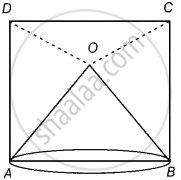
Construction: Join OC and OD.
To show: ΔOCD is an isosceles triangle.
Proof: Since, AOB is an equilateral triangle.
∴ ∠OAB = ∠OBA = 60° ...(i)
Also, ∠DAB = ∠CBA = 90° ...(ii) [Each angle of a square is 90°] [∵ ABCD is a square]
On subtracting equation (i) from equation (ii), we get
∠DAB – ∠OAB = ∠CBA – ∠OBA = 90° – 60°
i.e. ∠DAO = ∠CBO = 30°
In ΔAOD and ΔBOC,
AO = BO ...[Given] [All the side of an equilateral triangle are equal]
∠DAO = ∠CBO ...[Proved above]
And AD = BC ...[Sides of a square are equal]
∴ ΔAOD ≅ ΔBOC ...[By SAS congruence rule]
Hence, OD = OC ...[By CPCT]
In ΔCOD,
OC = OD
Hence, ΔCOD is an isosceles triangle.
Hence proved.
APPEARS IN
RELATED QUESTIONS
If the angles of a triangle are in the ratio 1: 2 : 3, determine three angles.
Can a triangle have two obtuse angles? Justify your answer in case.
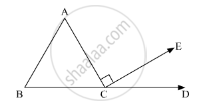
In the given figure, AC ⊥ CE and ∠A : ∠B : ∠C = 3 : 2 : 1, find the value of ∠ECD.
In Δ ABC, if u∠B = 60°, ∠C = 80° and the bisectors of angles ∠ABC and ∠ACB meet at a point O, then find the measure of ∠BOC.
State exterior angle theorem.
In ΔPQR, If ∠R > ∠Q then ______.
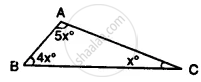
Find the value of the angle in the given figure:
Can 30°, 60° and 90° be the angles of a triangle?
In ΔABC, name the 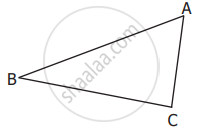
a) Three sides: _________, __________, __________
b) Three Angles: _________, __________, __________
c) Three Vertices: _________, __________, __________
Can we have two acute angles whose sum is a straight angle? Why or why not?
