Advertisements
Advertisements
Question
The bisectors of base angles of a triangle cannot enclose a right angle in any case.
Advertisements
Solution
In a ABC
Sum of all angles of triangles is `180^@`
i.e, `∠ A+∠ B+∠C =180^@` divide both sides by `2`
⇒ `1/2∠A+1/2∠B+1/2∠C=180^@`
⇒`1/2∠A+∠OBC+∠OBC=90^@` [∵ OB,OC insects ∠B and ∠C]
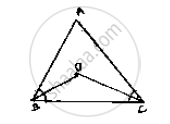
⇒`∠OBC+∠OCB=90^@-1/2A`
Now in `Δ OCB=180^@`
`∴ ∠ BOC+∠OBC+∠OCB=180^@`
⇒`∠ BOC+90^@-1/2∠A=180^@`
⇒ `∠ BOC=90^@-1/2 ∠A`
Hence, bisectors of a base angle cannot enclose right angle.
APPEARS IN
RELATED QUESTIONS
If the bisector of the exterior vertical angle of a triangle be parallel to the base. Show that the triangle is isosce
Determine the measure of each of the equal angles of a right-angled isosceles triangle.
OR
ABC is a right-angled triangle in which ∠A = 90° and AB = AC. Find ∠B and ∠C.
In a Δ ABC, AD bisects ∠A and ∠C > ∠B. Prove that ∠ADB > ∠ADC.
One angle of a triangle is 60°. The other two angles are in the ratio of 5: 7. Find the two angles.
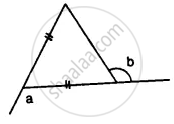
In the given figure, express a in terms of b.
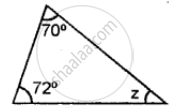
In the following, find the marked unknown angle:
Match the following:
| Column A | Column B |
| (i) No sides are equal | Isosceles triangle |
| (ii) One right angle | Scalene triangle |
| (iii) One obtuse angle | Right angled triangle |
| (iv) Two sides of equal length | Equilateral triangle |
| (v) All sides are equal | Obtuse angled triangle |
In the following figure, l || m and M is the mid-point of a line segment AB. Show that M is also the mid-point of any line segment CD, having its end points on l and m, respectively.

Can we have two acute angles whose sum is a straight angle? Why or why not?
How is a vertex of triangle △ABC most accurately defined?
