Advertisements
Advertisements
प्रश्न
The bisectors of base angles of a triangle cannot enclose a right angle in any case.
Advertisements
उत्तर
In a ABC
Sum of all angles of triangles is `180^@`
i.e, `∠ A+∠ B+∠C =180^@` divide both sides by `2`
⇒ `1/2∠A+1/2∠B+1/2∠C=180^@`
⇒`1/2∠A+∠OBC+∠OBC=90^@` [∵ OB,OC insects ∠B and ∠C]
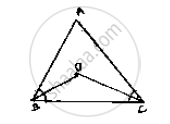
⇒`∠OBC+∠OCB=90^@-1/2A`
Now in `Δ OCB=180^@`
`∴ ∠ BOC+∠OBC+∠OCB=180^@`
⇒`∠ BOC+90^@-1/2∠A=180^@`
⇒ `∠ BOC=90^@-1/2 ∠A`
Hence, bisectors of a base angle cannot enclose right angle.
APPEARS IN
संबंधित प्रश्न
If the bisectors of the base angles of a triangle enclose an angle of 135°, prove that the triangle is a right triangle.
Can a triangle have two acute angles?Justify your answer in case.
If the bisector of the exterior vertical angle of a triangle be parallel to the base. Show that the triangle is isosce
Is the following statement true and false :
All the angles of a triangle can be less than 60°
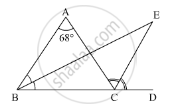
In the given figure, side BC of ΔABC is produced to point D such that bisectors of ∠ABC and ∠ACD meet at a point E. If ∠BAC = 68°, find ∠BEC.
If one angle of a triangle is equal to the sum of the other two angles, then the triangle is
One of the base angles of an isosceles triangle is 52°. Find its angle of the vertex.
Find, giving a reason, the unknown marked angles, in a triangle drawn below:

One of the angles of a triangle is 65°. If the difference of the other two angles is 45°, then the two angles are
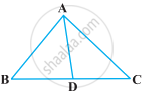
In the following figure, AD is the bisector of ∠BAC. Prove that AB > BD.