Advertisements
Advertisements
प्रश्न
Match the following:
| Column A | Column B |
| (i) No sides are equal | Isosceles triangle |
| (ii) One right angle | Scalene triangle |
| (iii) One obtuse angle | Right angled triangle |
| (iv) Two sides of equal length | Equilateral triangle |
| (v) All sides are equal | Obtuse angled triangle |
Advertisements
उत्तर
| Column A | Column B |
| (i) No sides are equal | Scalene triangle |
| (ii) One right angle | Right angled triangle |
| (iii) One obtuse angle | Obtuse angled triangle |
| (iv) Two sides of equal length | Isosceles triangle |
| (v) All sides are equal | Equilateral triangle |
APPEARS IN
संबंधित प्रश्न
If one angle of a triangle is equal to the sum of the other two, show that the triangle is a
right triangle.
Can a triangle have All angles less than 60° Justify your answer in case.
Is the following statement true and false :
An exterior angle of a triangle is equal to the sum of the two interior opposite angles.
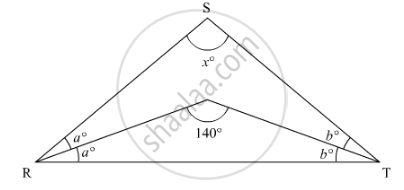
In ΔRST (See figure), what is the value of x?
Find the value of the angle in the given figure:
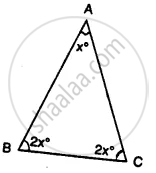
In the following, find the marked unknown angle:
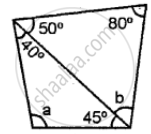
In the following, find the marked unknown angle:
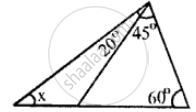
Find, giving a reason, the unknown marked angles, in a triangle drawn below:

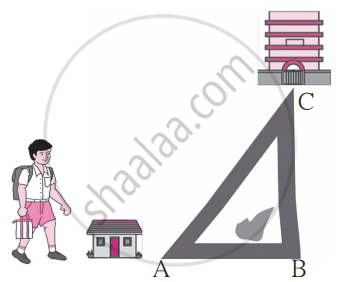
As shown in the figure, Avinash is standing near his house. He can choose from two roads to go to school. Which way is shorter? Explain why.
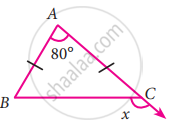
In a ∆ABC, AB = AC. The value of x is ________