Advertisements
Advertisements
प्रश्न
Is the following statement true and false :
If one angle of a triangle is obtuse, then it cannot be a right angled triangle.
विकल्प
Ture
False
Advertisements
उत्तर
If one angle of a triangle is obtuse, then it cannot be a right angles triangle.

According to the angle sum property of the triangle
In ΔABC
∠A +∠B + ∠C = 180°
Now, if it is a right angled triangle
Then,
∠A + ∠B + ∠C = 180°
90° + ∠B + ∠C =180°
∠B +∠C = 90°
Also if one of the angle’s is obtuse
∠B +∠C > 90°
This is not possible.
Thus, if one angle of a triangle is obtuse, then it cannot be a right angled triangle.
APPEARS IN
संबंधित प्रश्न
In a ΔABC, if ∠A = 55°, ∠B = 40°, find ∠C.
The angles of a triangle are arranged in ascending order of magnitude. If the difference
between two consecutive angles is 10°, find the three angles.
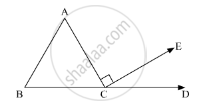
In the given figure, AC ⊥ CE and ∠A : ∠B : ∠C = 3 : 2 : 1, find the value of ∠ECD.
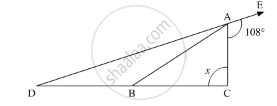
In the given figure, AB divides ∠DAC in the ratio 1 : 3 and AB = DB. Determine the value of x.
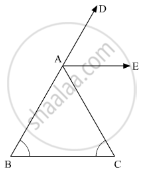
In the given figure, AE bisects ∠CAD and ∠B= ∠C. Prove that AE || BC.
If two acute angles of a right triangle are equal, then each acute is equal to
Side BC of a triangle ABC has been produced to a point D such that ∠ACD = 120°. If ∠B = \[\frac{1}{2}\]∠A is equal to
In ΔABC, ∠B = ∠C and ray AX bisects the exterior angle ∠DAC. If ∠DAX = 70°, then ∠ACB =
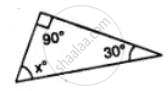
Calculate the unknown marked angles of the following figure :
What is common in the following figure?
 |
 |
| (i) | (ii) |
Is figure (i) that of triangle? if not, why?
