Advertisements
Advertisements
Question
Match the following:
| Column A | Column B |
| (i) No sides are equal | Isosceles triangle |
| (ii) One right angle | Scalene triangle |
| (iii) One obtuse angle | Right angled triangle |
| (iv) Two sides of equal length | Equilateral triangle |
| (v) All sides are equal | Obtuse angled triangle |
Advertisements
Solution
| Column A | Column B |
| (i) No sides are equal | Scalene triangle |
| (ii) One right angle | Right angled triangle |
| (iii) One obtuse angle | Obtuse angled triangle |
| (iv) Two sides of equal length | Isosceles triangle |
| (v) All sides are equal | Equilateral triangle |
APPEARS IN
RELATED QUESTIONS
Can a triangle have All angles more than 60°? Justify your answer in case.
Is the following statement true and false :
All the angles of a triangle can be greater than 60°.
Fill in the blank to make the following statement true:
An exterior angle of a triangle is equal to the two ....... opposite angles.
In a triangle, an exterior angle at a vertex is 95° and its one of the interior opposite angle is 55°, then the measure of the other interior angle is
The bisects of exterior angle at B and C of ΔABC meet at O. If ∠A = x°, then ∠BOC =
State, if the triangle is possible with the following angles :
125°, 40°, and 15°
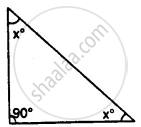
Find the unknown marked angles in the given figure:
Can a triangle together have the following angles?
33°, 74° and 73°
Find x, if the angles of a triangle is:
x°, 2x°, 2x°
The length of the three segments is given for constructing a triangle. Say whether a triangle with these sides can be drawn. Give the reason for your answer.
12 cm, 12 cm, 16 cm
