Advertisements
Advertisements
Question
In ∆ABC, C = 56° C = 56° ∠B = ∠C and ∠A = 100° ; find ∠B.
Advertisements
Solution
∠A + ∠B + ∠C = 180°
⇒ 100° + ∠B + ∠B = 180°
⇒ 2∠B = 180° 100°
∠B = `(80°)/2`
∠B = 40°
∠C = ∠B = 40°
APPEARS IN
RELATED QUESTIONS
In a ΔABC, ∠ABC = ∠ACB and the bisectors of ∠ABC and ∠ACB intersect at O such that ∠BOC = 120°. Show that ∠A = ∠B = ∠C = 60°.
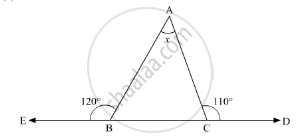
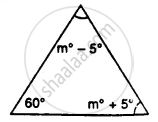
Compute the value of x in the following figure:
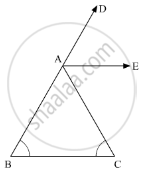
In the given figure, AE bisects ∠CAD and ∠B= ∠C. Prove that AE || BC.
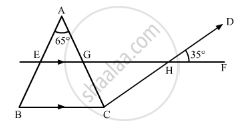
In the given figure, if AB || CD, EF || BC, ∠BAC = 65° and ∠DHF = 35°, find ∠AGH.
Find the unknown marked angles in the given figure:
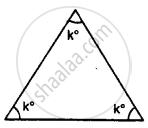
Find the unknown marked angles in the given figure:
In ΔABC, name the 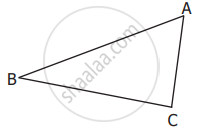
a) Three sides: _________, __________, __________
b) Three Angles: _________, __________, __________
c) Three Vertices: _________, __________, __________
S is any point on side QR of a ∆PQR. Show that: PQ + QR + RP > 2PS.
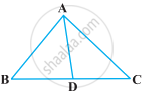
In the following figure, AD is the bisector of ∠BAC. Prove that AB > BD.
Can we have two acute angles whose sum is a right angle? Why or why not?
