Advertisements
Advertisements
Question
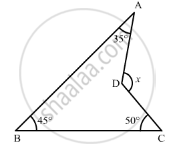
Find, giving a reason, the unknown marked angles, in a triangle drawn below:

Advertisements
Solution
We know that,
Exterior angle of a triangle is always equal to the sum of its two interior opposite angles (property)
∴ 110° = x + 30° (by property)
⇒ x = 110°- 30°
x = 80°
APPEARS IN
RELATED QUESTIONS
In a ΔABC, if ∠A = 55°, ∠B = 40°, find ∠C.
Two angles of a triangle are equal and the third angle is greater than each of those angles
by 30°. Determine all the angles of the triangle.
If the bisector of the exterior vertical angle of a triangle be parallel to the base. Show that the triangle is isosce
Determine the measure of each of the equal angles of a right-angled isosceles triangle.
OR
ABC is a right-angled triangle in which ∠A = 90° and AB = AC. Find ∠B and ∠C.
Is the following statement true and false :
All the angles of a triangle can be greater than 60°.
In the given figure, compute the value of x.
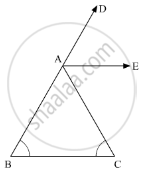
In the given figure, AE bisects ∠CAD and ∠B= ∠C. Prove that AE || BC.
Calculate the angles of a triangle if they are in the ratio 4: 5: 6.
Find x, if the angles of a triangle is:
x°, 2x°, 2x°
Draw a rough sketch of a triangle ABC. Mark a point P in its interior and a point Q in its exterior. Is point A in its exterior or in its interior?
