Advertisements
Advertisements
Question
AB and CD are the smallest and largest sides of a quadrilateral ABCD. Out of ∠B and ∠D decide which is greater.
Advertisements
Solution
Given: In quadrilateral ABCD, AB is the smallest and CD is the largest side
To find: ∠B > ∠D or ∠D > ∠B.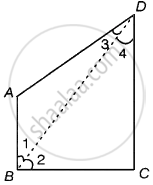
Construction: Join BD.
Now, in ΔABD, AD > AB ...[Since, AB is the smallest side in ABCD]
⇒ ∠1 > ∠3 [Angle opposite to larger side is greater] ...(i)
In ΔBCD, CD > BC ...[Since, CD is the largest side in ABCD]
⇒ ∠2 > ∠4 [Angle opposite to larger side is greater] ...(ii)
On adding equations (i) and (ii), we get
∠1 + ∠2 > ∠3 + ∠4
Hence, ∠B > ∠D
APPEARS IN
RELATED QUESTIONS
Can a triangle have All angles less than 60° Justify your answer in case.
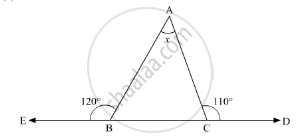
Compute the value of x in the following figure:
In ΔPQR, If ∠R > ∠Q then ______.
State, if the triangle is possible with the following angles :
60°, 60°, and 50°
One angle of a triangle is 61° and the other two angles are in the ratio `1 1/2: 1 1/3`. Find these angles.
The length of the sides of the triangle is given. Say what types of triangles they are 3.4 cm, 3.4 cm, 5 cm.
The length of the three segments is given for constructing a triangle. Say whether a triangle with these sides can be drawn. Give the reason for your answer.
17 cm, 7 cm, 8 cm
The angles of a triangle are in the ratio 2 : 3 : 4. Then the angles are
Can we have two acute angles whose sum is an acute angle? Why or why not?
Can we have two acute angles whose sum is a reflex angle? Why or why not?
