Advertisements
Advertisements
Question
The angles of a triangle are arranged in ascending order of magnitude. If the difference
between two consecutive angles is 10°, find the three angles.
Advertisements
Solution
Given that,
The difference between two consecutive angles is `10^@`
Let x,x+10,x+20 be the consecutive angles differ by `10^@`
W.K.T sum of all angles of traingle is `180^@`
`x+x+10+x+20=180^@`
`3x+30=180^@`
⇒ `3x=180-30^@ ⇒ 3x=150^@`
⇒`x=50^@`
∴ `x=50^@`
∴ The required angles are
x,x+10 and x+20
x=50
x+10=50+10=60
x+20=50+10+10=70
The difference between two consecutive angles is `10^@` then three angles are ` 50^@,60^@ and 70^@`
APPEARS IN
RELATED QUESTIONS
Can a triangle have two right angles? Justify your answer in case.
Can a triangle have All angles equal to 60°? Justify your answer in case.
Is the following statement true and false :
A triangle can have two obtuse angles.
State, if the triangle is possible with the following angles :
40°, 130°, and 20°
The correct statement out of the following is 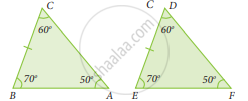
The angles of the triangle are 3x – 40, x + 20 and 2x – 10 then the value of x is
If an angle of a triangle is equal to the sum of the other two angles, find the type of the triangle
In ΔABC, name the 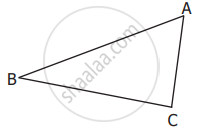
a) Three sides: _________, __________, __________
b) Three Angles: _________, __________, __________
c) Three Vertices: _________, __________, __________
S is any point on side QR of a ∆PQR. Show that: PQ + QR + RP > 2PS.
In the following figure, ∠BAC = 90° and AD ⊥ BC. The number of right triangles in the figure is ______.

