Advertisements
Advertisements
प्रश्न
Find all the angles of an equilateral triangle.
Advertisements
उत्तर
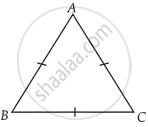
Let ABC be an equilateral triangle such that AB = BC = CA
We have, AB = AC ⇒ ∠C = ∠B ...[Angle opposite to equal sides are equal]
Let ∠C = ∠B = x° ...(i)
Now, BC = BA
⇒ ∠A = ∠C ...(ii) [Angles opposite to equal sides are equal]
From equations (i) and (ii),
∠A = ∠B = ∠C = x
Now, in ΔABC, ∠A + ∠B + ∠C = 180° ...[By angle sum property of a triangle]
⇒ x + x + x = 180°
⇒ 3x = 180°
∴ x = 60°
Hence, ∠A = ∠B = ∠C = 60°
APPEARS IN
संबंधित प्रश्न
Show that the angles of an equilateral triangle are 60° each.
If the base of an isosceles triangle is produced on both sides, prove that the exterior angles so formed are equal to each other.
In a ΔABC, if ∠A=l20° and AB = AC. Find ∠B and ∠C.
BD and CE are bisectors of ∠B and ∠C of an isosceles ΔABC with AB = AC. Prove that BD = CE.
If the bisector of the exterior vertical angle of a triangle be parallel to the base. Show that the triangle is isosceles.
P is a point on the bisector of an angle ∠ABC. If the line through P parallel to AB meets BC at Q, prove that triangle BPQ is isosceles.
Prove that each angle of an equilateral triangle is 60°.
Which of the following statements are true (T) and which are false (F):
The bisectors of two equal angles of a triangle are equal
Which of the following statements are true (T) and which are false (F):
If the bisector of the vertical angle of a triangle bisects the base, then the triangle may be isosceles.
Fill the blank in the following so that the following statement is true.
In a ΔABC if ∠A = ∠C , then AB = ......
Prove that the perimeter of a triangle is greater than the sum of its altitudes.
Fill in the blank to make the following statement true.
If two angles of a triangle are unequal, then the smaller angle has the........ side opposite to it.
ABC is a triangle. The bisector of the exterior angle at B and the bisector of ∠C intersect each other at D. Prove that ∠D = \[\frac{1}{2}\] ∠A.
If the angles of a triangle are in the ratio 2 : 1 : 3, then find the measure of smallest angle.
In the given figure, what is z in terms of x and y?
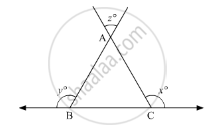
In the given figure, the value of x is ______.
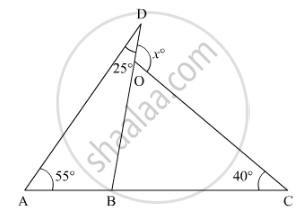
In the given figure, if BP || CQ and AC = BC, then the measure of x is
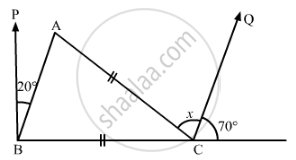
In ∆PQR, ∠R = ∠P and QR = 4 cm and PR = 5 cm. Then the length of PQ is ______.
In triangles ABC and PQR, AB = AC, ∠C = ∠P and ∠B = ∠Q. The two triangles are ______.
In ∆PQR, ∠P = 70° and ∠R = 30°. Which side of this triangle is the longest? Give reason for your answer.
