Advertisements
Advertisements
प्रश्न
Side BC of a triangle ABC has been produced to a point D such that ∠ACD = 120°. If ∠B = \[\frac{1}{2}\]∠A is equal to
विकल्प
80°
75°
60°
90°
Advertisements
उत्तर
In the given problem, side BC of ΔABC has been produced to a point D. Such that ∠ACD = 120° and `∠B = 1/2 ∠A` . Here, we need to find ∠A
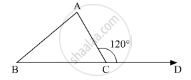
Given `∠B = 1/2 ∠A`
We get, ∠A = 2∠B .........(1)
Now, using the property, “exterior angle of a triangle is equal to the sum of two opposite interior angles”, we get,
In ΔABC
∠ACD = ∠A + ∠B
120° = 2∠B + ∠B
120° = 3∠B
`∠B = (120°)/3`
∠B = 40°
Also, ∠A = 2∠B(Using 1)
∠ A = 2 (40°)
= 80°
Thus, ∠A = 80°
APPEARS IN
संबंधित प्रश्न
Can a triangle have two right angles? Justify your answer in case.
In Δ ABC, BD⊥ AC and CE ⊥ AB. If BD and CE intersect at O, prove that ∠BOC = 180° − A.
In ΔABC, if bisectors of ∠ABC and ∠ACB intersect at O at angle of 120°, then find the measure of ∠A.
Mark the correct alternative in each of the following:
If all the three angles of a triangle are equal, then each one of them is equal to
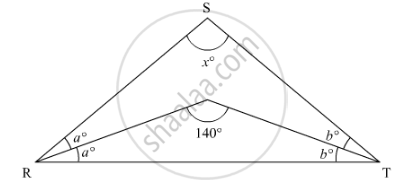
In ΔRST (See figure), what is the value of x?
Find x, if the angles of a triangle is:
x°, x°, x°
In ΔABC, name the 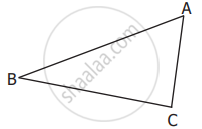
a) Three sides: _________, __________, __________
b) Three Angles: _________, __________, __________
c) Three Vertices: _________, __________, __________
Can we have two acute angles whose sum is an acute angle? Why or why not?
Can we have two acute angles whose sum is an obtuse angle? Why or why not?
Draw a rough sketch of a triangle ABC. Mark a point P in its interior and a point Q in its exterior. Is point A in its exterior or in its interior?
