Advertisements
Advertisements
प्रश्न
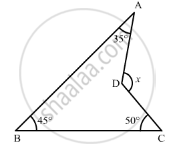
In the given figure, compute the value of x.
Advertisements
उत्तर
In the given figure,∠DCB = 45, ∠CBA = 45 and ∠BAD = 35
Here, we will produce AD to meet BC at E

Now, using angle sum property of the triangle
In ΔAEB
∠BAE +∠AEB + ∠EBA = 180°
∠AED + 35°+ 45° = 180°
∠AEB + 80° = 180°
∠AEB = 180° - 80°
∠AEB = 100°
Further, BEC is a straight line. So, using the property, “the angles forming a linear pair are supplementary”, we get,
∠AEB + ∠AEC = 180°
100 + ∠AEC = 180°
∠AEC = 180°- 100°
∠AEC = 80°
Also, using the property, “an exterior angle of a triangle is equal to the sum of its two opposite interior angles”
In ΔDEC, x is its exterior angle
Thus,
∠X = ∠DCE + ∠DEC
= 50° + 80°
= 130°
Therefore, X = 130°.
APPEARS IN
संबंधित प्रश्न
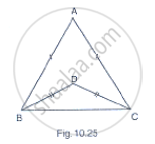
In Fig. 10.25, AB = AC and DB = DC, find the ratio ∠ABD : ∠ACD.
Determine the measure of each of the equal angles of a right-angled isosceles triangle.
OR
ABC is a right-angled triangle in which ∠A = 90° and AB = AC. Find ∠B and ∠C.
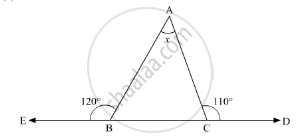
Compute the value of x in the following figure:
In Δ ABC, if u∠B = 60°, ∠C = 80° and the bisectors of angles ∠ABC and ∠ACB meet at a point O, then find the measure of ∠BOC.
State, if the triangle is possible with the following angles :
125°, 40°, and 15°
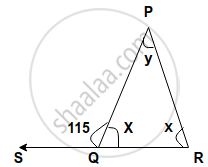
Find, giving a reason, the unknown marked angles, in a triangle drawn below:
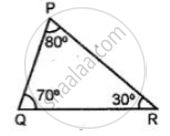
Classify the following triangle according to angle:
The length of the sides of the triangle is given. Say what types of triangles they are 3.7 cm, 3.4 cm, 4 cm.
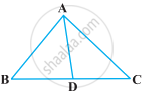
In the following figure, AD is the bisector of ∠BAC. Prove that AB > BD.
In the following figure, ∠BAC = 90° and AD ⊥ BC. The number of right triangles in the figure is ______.

