Advertisements
Advertisements
Question
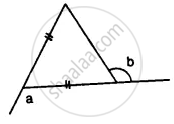
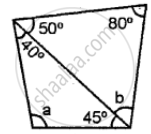
In the given figure, express a in terms of b.
Advertisements
Solution
In Δ ABC,
BC = BA
∴ ∠BCA = ∠BAC
and Ext. ∠CBE = ∠BCA + ∠BAC
⇒ a = ∠BCA + ∠BCA
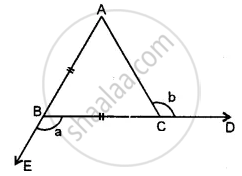
⇒ a = 2 ∠BCA .........(i)
But ∠ACB = 180° − b ..........(∵ ∠ACD and ∠ACB are linear pair)
⇒ ∠BCA = 180° − b .............(ii)
∴ a = 2 ∠BCA = 2 (180° − b)
= 360°− 2b
APPEARS IN
RELATED QUESTIONS
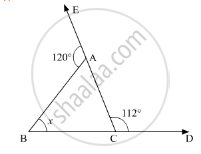
Compute the value of x in the following figure:
Is the following statement true and false :
If one angle of a triangle is obtuse, then it cannot be a right angled triangle.
Is the following statement true and false :
An exterior angle of a triangle is less than either of its interior opposite angles.
Define a triangle.
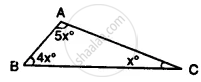
Find the value of the angle in the given figure:
Find the unknown marked angles in the given figure:
One angle of a triangle is 60°. The other two angles are in the ratio of 5: 7. Find the two angles.
In the following, find the marked unknown angle:
Can a triangle together have the following angles?
33°, 74° and 73°
The length of the three segments is given for constructing a triangle. Say whether a triangle with these sides can be drawn. Give the reason for your answer.
9 cm, 6 cm, 16 cm
