Advertisements
Advertisements
प्रश्न
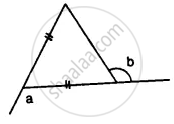
In the given figure, express a in terms of b.
Advertisements
उत्तर
In Δ ABC,
BC = BA
∴ ∠BCA = ∠BAC
and Ext. ∠CBE = ∠BCA + ∠BAC
⇒ a = ∠BCA + ∠BCA
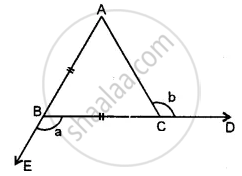
⇒ a = 2 ∠BCA .........(i)
But ∠ACB = 180° − b ..........(∵ ∠ACD and ∠ACB are linear pair)
⇒ ∠BCA = 180° − b .............(ii)
∴ a = 2 ∠BCA = 2 (180° − b)
= 360°− 2b
APPEARS IN
संबंधित प्रश्न
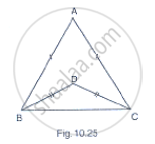
In Fig. 10.25, AB = AC and DB = DC, find the ratio ∠ABD : ∠ACD.
Mark the correct alternative in each of the following:
If all the three angles of a triangle are equal, then each one of them is equal to
If two sides of a triangle are 5 cm and 1.5 cm, the length of its third side cannot be ______.
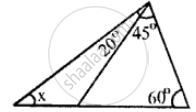
In the following, find the marked unknown angle:
Can a triangle together have the following angles?
55°, 55° and 80°
Find x, if the angles of a triangle is:
2x°, 4x°, 6x°
The length of the sides of the triangle is given. Say what types of triangles they are 3.4 cm, 3.4 cm, 5 cm.
The angles of a triangle are in the ratio 2 : 3 : 4. Then the angles are
Match the following:
| Column A | Column B |
| (i) No sides are equal | Isosceles triangle |
| (ii) One right angle | Scalene triangle |
| (iii) One obtuse angle | Right angled triangle |
| (iv) Two sides of equal length | Equilateral triangle |
| (v) All sides are equal | Obtuse angled triangle |
How many angles are there inside a triangle?
