Advertisements
Advertisements
Question
One of the base angles of an isosceles triangle is 52°. Find its angle of the vertex.
Advertisements
Solution
Each of the base angles of an isosceles
Δ ABC = 52°
∴ ∠B = ∠C = 52°

But ∠A + ∠B + ∠C = 180°..........(Angles of a triangle)
⇒ ∠A + 52° + 52° = 180°
⇒ ∠A + 104° = 180°
⇒ ∠A = 180°− 104° = 76°
Hence ∠A = 76°
APPEARS IN
RELATED QUESTIONS
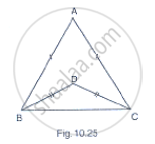
In Fig. 10.25, AB = AC and DB = DC, find the ratio ∠ABD : ∠ACD.
The exterior angles, obtained on producing the base of a triangle both way are 104° and 136°. Find all the angles of the triangle.
Is the following statement true and false :
A triangle can have two right angles.
Is the following statement true and false :
All the angles of a triangle can be less than 60°
If one angle of a triangle is equal to the sum of the other two angles, then the triangle is
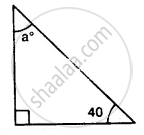
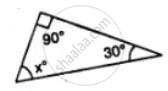
Calculate the unknown marked angles of the following figure :
Calculate the unknown marked angles of the following figure :
Prove that in a triangle, other than an equilateral triangle, angle opposite the longest side is greater than `2/3` of a right angle.
What is common in the following figure?
 |
 |
| (i) | (ii) |
Is figure (i) that of triangle? if not, why?
Jincy used these shapes to make drawings of fish.

Now you also use some shapes to draw the different sea animals shown below.

Sea urchin

Lobster

Eel

Red snapper

Octopus

Clam

Parrotfish

Prawn

Cuttlefish

Jellyfish

Squid

Silver pomfret

Crab
