Advertisements
Advertisements
Question
In a triangle PQR, ∠P = 60° and ∠Q = ∠R, find ∠R.
Advertisements
Solution
Let ∠Q = ∠R = x, ∠P = 60°
But ∠P + ∠Q + ∠R = 180°
∴ 60° + x + x = 180°
⇒ 60° + 2x = 180°
⇒ 2x = 180° − 60° = 120°
⇒ x =`(120°)/2`=60°
∴ ∠Q = ∠R = 60°
Hence, ∠R = 60°
APPEARS IN
RELATED QUESTIONS
If the bisector of the exterior vertical angle of a triangle be parallel to the base. Show that the triangle is isosce
In the given figure, AB || DE. Find ∠ACD.
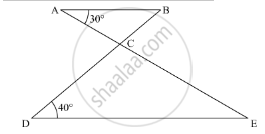
Fill in the blank to make the following statement true:
An exterior angle of a triangle is always ......... than either of the interior opposite angles.
Fill in the blank to make the following statement true:
A triangles cannot have more than ......obtuse angles.
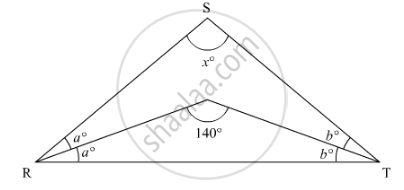
In ΔRST (See figure), what is the value of x?
In the given figure, show that: ∠a = ∠b + ∠c
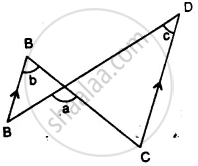
(i) If ∠b = 60° and ∠c = 50° ; find ∠a.
(ii) If ∠a = 100° and ∠b = 55° : find ∠c.
(iii) If ∠a = 108° and ∠c = 48° ; find ∠b.
Can 30°, 60° and 90° be the angles of a triangle?
In a ∆ABC, AB = AC. The value of x is ________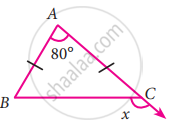
P is a point on the bisector of ∠ABC. If the line through P, parallel to BA meet BC at Q, prove that BPQ is an isosceles triangle.
What is the sum of the measures of the interior angles of any triangle, △ABC?
