Advertisements
Advertisements
Question
If each angle of a triangle is less than the sum of the other two, show that the triangle is acute angled.
Advertisements
Solution
Given each angle of a triangle less than the sum of the other two
`∴∠A+∠ B+∠C`
`⇒∠A+∠A<∠A+∠B+∠C`
`⇒2∠A<180^@`
[Sum of all angles of a triangle]
`⇒∠A<90^@`
Similarly` ∠ B< 90^@ and ∠C<90^@`
Hence, the triangles acute angled.
APPEARS IN
RELATED QUESTIONS
In a ΔABC, if ∠A = 55°, ∠B = 40°, find ∠C.
If one angle of a triangle is equal to the sum of the other two, show that the triangle is a
right triangle.
In a ΔABC, ∠ABC = ∠ACB and the bisectors of ∠ABC and ∠ACB intersect at O such that ∠BOC = 120°. Show that ∠A = ∠B = ∠C = 60°.
Can a triangle have two obtuse angles? Justify your answer in case.
Determine the measure of each of the equal angles of a right-angled isosceles triangle.
OR
ABC is a right-angled triangle in which ∠A = 90° and AB = AC. Find ∠B and ∠C.
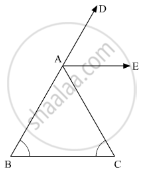
In the given figure, AE bisects ∠CAD and ∠B= ∠C. Prove that AE || BC.
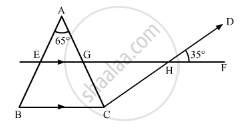
In the given figure, if AB || CD, EF || BC, ∠BAC = 65° and ∠DHF = 35°, find ∠AGH.
If two acute angles of a right triangle are equal, then each acute is equal to
One of the angles of a triangle is 65°. If the difference of the other two angles is 45°, then the two angles are
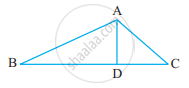
Identify three triangles in the figure.