Advertisements
Advertisements
प्रश्न
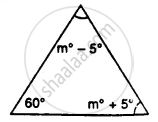
Find the unknown marked angles in the given figure:
Advertisements
उत्तर
In the figure,
∠A + ∠B + ∠C = 180° .....(Sum of angles of a triangle)
(m°− 5°) + 60° + (m°+ 5°) = 180°
⇒ m°− 5° + 60° + m° + 5° = 180°
⇒ 2m° = 180°− 65° + 5°
⇒ 2m° = 120°
⇒ ∴ m° = `(120°)/2=60°`
Hence ∠A = m°− 5° = 60°− 5° = 55°
and ∠C = m° + 5° = 60° + 5° = 65°
APPEARS IN
संबंधित प्रश्न
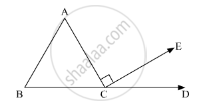
In the given figure, AC ⊥ CE and ∠A : ∠B : ∠C = 3 : 2 : 1, find the value of ∠ECD.
Is the following statement true and false :
An exterior angle of a triangle is less than either of its interior opposite angles.
Fill in the blank to make the following statement true:
An exterior angle of a triangle is always ......... than either of the interior opposite angles.
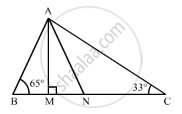
In the given figure, AM ⊥ BC and AN is the bisector of ∠A. If ∠B = 65° and ∠C = 33°, find ∠MAN.
An exterior angle of a triangle is equal to 100° and two interior opposite angles are equal. Each of these angles is equal to
Side BC of a triangle ABC has been produced to a point D such that ∠ACD = 120°. If ∠B = \[\frac{1}{2}\]∠A is equal to
State, if the triangle is possible with the following angles :
40°, 130°, and 20°
State, if the triangle is possible with the following angles :
60°, 60°, and 50°
The length of the three segments is given for constructing a triangle. Say whether a triangle with these sides can be drawn. Give the reason for your answer.
8.4 cm, 16.4 cm, 4.9 cm
Q is a point on the side SR of a ∆PSR such that PQ = PR. Prove that PS > PQ.
