Advertisements
Advertisements
प्रश्न
An exterior angle of a triangle is equal to 100° and two interior opposite angles are equal. Each of these angles is equal to
विकल्प
75°
80°
80°
40°
50°
Advertisements
उत्तर
n the ΔABC, CD is the ray extended from the vertex C of ΔABC. It is given that the exterior angle of the triangle is 100° and two of the interior opposite angles are equal.
So, ∠ACD = 100° and A = ∠B
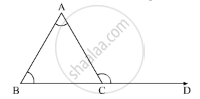
So, now using the property, “an exterior angle of the triangle is equal to the sum of the two opposite interior angles”, we get.
In ΔABC
∠A + ∠B = ∠ACD
∠2A = 100°
`∠A = (100°)/2`
∠A = 50°
∠A = ∠B = 50°
Therefore, each of the two opposite interior angles is 50°.
APPEARS IN
संबंधित प्रश्न
If each angle of a triangle is less than the sum of the other two, show that the triangle is acute angled.
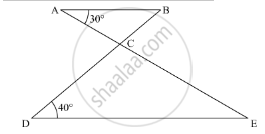
In the given figure, AB || DE. Find ∠ACD.
The sum of two angles of a triangle is equal to its third angle. Determine the measure of the third angle.
If one angle of a triangle is equal to the sum of the other two angles, then the triangle is
Find x, if the angles of a triangle is:
x°, 2x°, 2x°
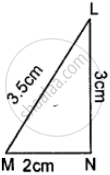
Classify the following triangle according to sides:
The angles of the triangle are 3x – 40, x + 20 and 2x – 10 then the value of x is
P is a point on the bisector of ∠ABC. If the line through P, parallel to BA meet BC at Q, prove that BPQ is an isosceles triangle.
Can we have two acute angles whose sum is an obtuse angle? Why or why not?
Can we have two acute angles whose sum is a reflex angle? Why or why not?
