Advertisements
Advertisements
प्रश्न
In ΔABC, if bisectors of ∠ABC and ∠ACB intersect at O at angle of 120°, then find the measure of ∠A.
Advertisements
उत्तर
In the given ΔABC, ∠ABC = ∠ACB, the bisectors of ∠ABC and ∠ACBmeet at O and ∠BOC = 120°
We need to find the measure of ∠A

So here, using the corollary, “if the bisectors of ∠ABCand ∠ACBof a ΔABCmeet at a point O, then`∠BOC = 90° + 1/2 ∠A`
Thus, in ΔABC
`∠BOC = 90° + 1/2 ∠A`
` 120° = 90° + 1/2 ∠A`
`120° - 90° + 1/2 ∠A`
∠A = 2(30°)
∠A= 60°
Thus, ∠A = 60°
APPEARS IN
संबंधित प्रश्न
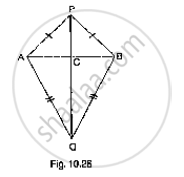
AB is a line segment. P and Q are points on opposite sides of AB such that each of them is equidistant from the points A and B (See Fig. 10.26). Show that the line PQ is perpendicular bisector of AB.
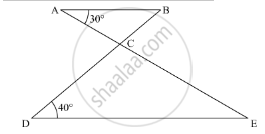
In the given figure, AB || DE. Find ∠ACD.
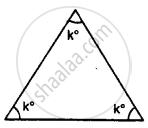
Is the following statement true and false :
All the angles of a triangle can be equal to 60°.
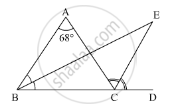
In the given figure, side BC of ΔABC is produced to point D such that bisectors of ∠ABC and ∠ACD meet at a point E. If ∠BAC = 68°, find ∠BEC.
State, if the triangle is possible with the following angles :
20°, 70°, and 90°
Find the unknown marked angles in the given figure:
One angle of a triangle is 61° and the other two angles are in the ratio `1 1/2: 1 1/3`. Find these angles.
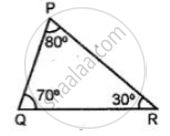
Classify the following triangle according to angle:

Classify the following triangle according to angle:
Can we have two acute angles whose sum is a reflex angle? Why or why not?
