Advertisements
Advertisements
प्रश्न
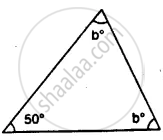
Find the unknown marked angles in the given figure:
Advertisements
उत्तर
In the figure,
∠A + ∠B + ∠C = 180° .....(Sum of angles of a triangle)
b° + 50° + b° = 180°
⇒ 2b° + 50° = 180°
⇒ 2b° = 180° − 50° = 130°
⇒ b° = `(130°)/2=65°`
Hence ∠A = b° = 65°
and ∠C = b° = 65°
APPEARS IN
संबंधित प्रश्न
The angles of a triangle are (x − 40)°, (x − 20)° and `(1/2x-10)^@.` find the value of x
If one angle of a triangle is equal to the sum of the other two, show that the triangle is a
right triangle.
An exterior angle of a triangle is 108° and its interior opposite angles are in the ratio 4 : 5. The angles of the triangle are
If the angles of a triangle are equal, find its angles.
Can a triangle together have the following angles?
85°, 95° and 22°
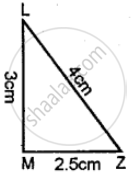
Classify the following triangle according to sides:
In the given figure, AB is parallel to CD. Then the value of b is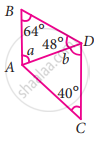
In ΔABC, name the 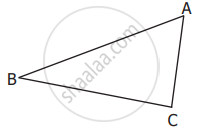
a) Three sides: _________, __________, __________
b) Three Angles: _________, __________, __________
c) Three Vertices: _________, __________, __________
Bisectors of the angles B and C of an isosceles triangle with AB = AC intersect each other at O. BO is produced to a point M. Prove that ∠MOC = ∠ABC.
The number of angles in the following figure is ______.

