Advertisements
Advertisements
Question
In a ΔABC, if ∠A = 55°, ∠B = 40°, find ∠C.
Advertisements
Solution
Given `∠ A=55^@,∠ B=40^@` then ∠ C=?
We know that
In a ABC sum of all angles of triangle is 180°
i.e, ∠ A+∠ B +∠ C =`180^@`
⇒`55^@+40^@` ∠ C `=180^@`
⇒`95^@+∠ C=180^@`
⇒`∠ C=180^@-95^@`
⇒`∠C=85^@`
APPEARS IN
RELATED QUESTIONS
Can a triangle have two right angles? Justify your answer in case.
In Δ ABC, if u∠B = 60°, ∠C = 80° and the bisectors of angles ∠ABC and ∠ACB meet at a point O, then find the measure of ∠BOC.
Find the value of the angle in the given figure:
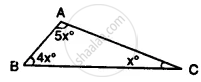
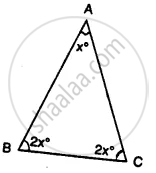
Find the value of the angle in the given figure:
In the given figure, show that: ∠a = ∠b + ∠c
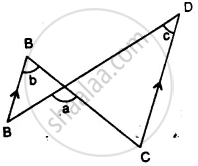
(i) If ∠b = 60° and ∠c = 50° ; find ∠a.
(ii) If ∠a = 100° and ∠b = 55° : find ∠c.
(iii) If ∠a = 108° and ∠c = 48° ; find ∠b.
Find x, if the angles of a triangle is:
x°, x°, x°
One of the angles of a triangle is 65°. If the difference of the other two angles is 45°, then the two angles are
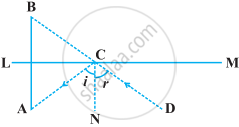
The image of an object placed at a point A before a plane mirror LM is seen at the point B by an observer at D as shown in the following figure. Prove that the image is as far behind the mirror as the object is in front of the mirror.
[Hint: CN is normal to the mirror. Also, angle of incidence = angle of reflection].
Can we have two acute angles whose sum is an acute angle? Why or why not?
The sides of a triangle must always be connected so that:
