Advertisements
Advertisements
Question
Is the following statement true and false :
All the angles of a triangle can be less than 60°
Options
True
False
Advertisements
Solution
All the angles of a triangle can be less than 60°

According to the angle sum property of the triangle
In ΔABC
∠A +∠B +∠C = 180°
Now, If all the three angles of a triangle is less than 60°
Then,
∠A +∠B +∠C < 180°
APPEARS IN
RELATED QUESTIONS
If the bisector of the exterior vertical angle of a triangle be parallel to the base. Show that the triangle is isosce
Determine the measure of each of the equal angles of a right-angled isosceles triangle.
OR
ABC is a right-angled triangle in which ∠A = 90° and AB = AC. Find ∠B and ∠C.
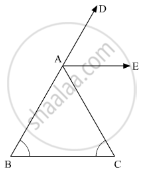
In the given figure, AE bisects ∠CAD and ∠B= ∠C. Prove that AE || BC.
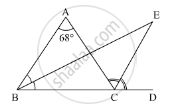
In the given figure, side BC of ΔABC is produced to point D such that bisectors of ∠ABC and ∠ACD meet at a point E. If ∠BAC = 68°, find ∠BEC.
Side BC of a triangle ABC has been produced to a point D such that ∠ACD = 120°. If ∠B = \[\frac{1}{2}\]∠A is equal to
If the sides of a triangle are produced in order, then the sum of the three exterior angles so formed is
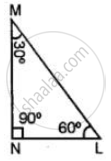
Classify the following triangle according to angle:
P is a point on the bisector of ∠ABC. If the line through P, parallel to BA meet BC at Q, prove that BPQ is an isosceles triangle.
Can we have two acute angles whose sum is an acute angle? Why or why not?
Can we have two acute angles whose sum is an obtuse angle? Why or why not?
