Advertisements
Advertisements
प्रश्न
Bisectors of the angles B and C of an isosceles triangle with AB = AC intersect each other at O. BO is produced to a point M. Prove that ∠MOC = ∠ABC.
Advertisements
उत्तर
Given in the question, bisectors of the angles B and C of an isosceles triangle ABC with AB = AC intersect each other at O. Now BO is produced to a point M.

In triangle ABC,
AB = AC
∠ABC = ∠ACB ...[Angle opposite to equal sides of a triangle are equal]
`1/2 ∠ABC = 1/2 ∠ACB`
That is ∠1 = ∠2 ...[Since, BO and CO are bisectors of ∠B and ∠C]
In triangle OBC,
Exterior ∠MOC = ∠1 + ∠2 ...[Exterior angle of a triangle is equal to the sum of interior opposite angles]
Exterior ∠MOC = 2∠1 ...[∠1 = ∠2]
Hence, ∠MOC = ∠ABC.
APPEARS IN
संबंधित प्रश्न
Can a triangle have two obtuse angles? Justify your answer in case.
Can a triangle have All angles more than 60°? Justify your answer in case.
Fill in the blank to make the following statement true:
Sum of the angles of a triangle is ....
One angle of a triangle is 60°. The other two angles are in the ratio of 5: 7. Find the two angles.
The length of the three segments is given for constructing a triangle. Say whether a triangle with these sides can be drawn. Give the reason for your answer.
7 cm, 24 cm, 25 cm
In ΔABC, name the 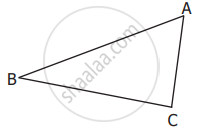
a) Three sides: _________, __________, __________
b) Three Angles: _________, __________, __________
c) Three Vertices: _________, __________, __________
P is a point on the bisector of ∠ABC. If the line through P, parallel to BA meet BC at Q, prove that BPQ is an isosceles triangle.
O is a point in the interior of a square ABCD such that OAB is an equilateral triangle. Show that ∆OCD is an isosceles triangle.
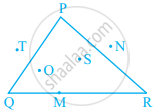
In the following figure, points lying in the interior of the triangle PQR are ______, that in the exterior are ______ and that on the triangle itself are ______.
Draw a rough sketch of a triangle ABC. Mark a point P in its interior and a point Q in its exterior. Is point A in its exterior or in its interior?
