Advertisements
Advertisements
प्रश्न
Bisectors of the angles B and C of an isosceles triangle ABC with AB = AC intersect each other at O. Show that external angle adjacent to ∠ABC is equal to ∠BOC
Advertisements
उत्तर

Given: ΔABC is an isosceles triangle in which AB = AC, BO and CO are the bisectors of ∠ABC and ∠ACB respectively intersect at O.
To show: ∠DBA = ∠BOC
Construction: Line CB produced to D.
Proof: In ΔABC, AB = AC ...[Given]
∠ACB = ∠ABC ...[Angles opposite to equal sides are equal]
⇒ `1/2 ∠ACB = 1/2 ∠ABC` ...[On dividing both sides by 2]
⇒ ∠OCB = ∠OBC ...(i) [∵ BO and CO are the bisectors of ∠ABC and ∠ACB]
In ΔBOC, ∠OBC + ∠OCB + ∠BOC = 180° ...[By angle sum property of a triangle]
⇒ ∠OBC + ∠OBC + ∠BOC = 180° ...[From equation (i)]
⇒ 2∠OBC + ∠BOC = 180°
⇒ ∠ABC + ∠BOC = 180° ...[∵ BO is the bisector of ∠ABC]
⇒ 180° – ∠DBA + ∠BOC = 180° ...[∵ DBC is a straight line]
⇒ – ∠DBA + ∠BOC = 0
⇒ ∠DBA = ∠BOC
APPEARS IN
संबंधित प्रश्न
In ΔABC, AD is the perpendicular bisector of BC (see the given figure). Show that ΔABC is an isosceles triangle in which AB = AC.

ABC is an isosceles triangle in which altitudes BE and CF are drawn to equal sides AC and AB respectively (see the given figure). Show that these altitudes are equal.

ΔABC is an isosceles triangle in which AB = AC. Side BA is produced to D such that AD = AB (see the given figure). Show that ∠BCD is a right angle.

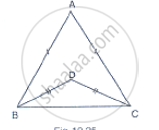
In figure, AB = AC and DB = DC, find the ratio ∠ABD : ∠ACD
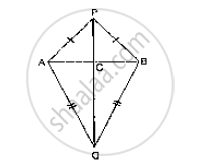
AB is a line seg P and Q are points on opposite sides of AB such that each of them is equidistant from the points A and B (See Fig. 10.26). Show that the line PQ is perpendicular bisector of AB.
If the base of an isosceles triangle is produced on both sides, prove that the exterior angles so formed are equal to each other.
P is a point on the bisector of an angle ∠ABC. If the line through P parallel to AB meets BC at Q, prove that triangle BPQ is isosceles.
Fill the blank in the following so that the following statement is true.
In an equilateral triangle all angles are .....
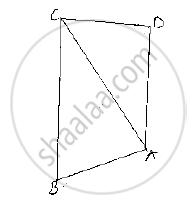
In Fig. 10.131, prove that: (i) CD + DA + AB + BC > 2AC (ii) CD + DA + AB > BC
Which of the following statements are true (T) and which are false (F)?
If two angles of a triangle are unequal, then the greater angle has the larger side opposite to it.
If the angles A, B and C of ΔABC satisfy the relation B − A = C − B, then find the measure of ∠B.
In ΔABC, if ∠A = 100°, AD bisects ∠A and AD ⊥ BC. Then, ∠B =
In a ΔABC, if ∠A = 60°, ∠B = 80° and the bisectors of ∠B and ∠C meet at O, then ∠BOC =
If the measures of angles of a triangle are in the ratio of 3 : 4 : 5, what is the measure of the smallest angle of the triangle?
In the given figure, if AB ⊥ BC. then x =
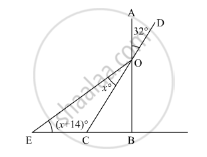
In the given figure, the value of x is ______.
In ∆PQR, ∠R = ∠P and QR = 4 cm and PR = 5 cm. Then the length of PQ is ______.
In ∆PQR, if ∠R > ∠Q, then ______.
In triangles ABC and PQR, AB = AC, ∠C = ∠P and ∠B = ∠Q. The two triangles are ______.
CDE is an equilateral triangle formed on a side CD of a square ABCD (Figure). Show that ∆ADE ≅ ∆BCE.

