Advertisements
Advertisements
प्रश्न
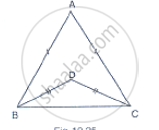
In figure, AB = AC and DB = DC, find the ratio ∠ABD : ∠ACD
Advertisements
उत्तर
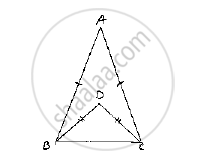
Consider the figure Given
AB = AC, DB = DC and given to find the ratio
∠ABD = ∠ACD
Now,∠ABC and ∠DBC are isosceles triangles since AB = AC and
DB = DC respectively
⇒ ∠ABC = ∠ACB and ∠DBC = ∠DCB [ ∵ angles opposite to equal sides are equal]
Now consider,
∠ABD : ∠ACD
⇒ (∠ABC - ∠DBC ) : (∠ACB - ∠DCB)
⇒ (∠ABC - ∠DBC ) : (∠ABC - ∠DBC ) [∵∠ABC - ∠ACB and ∠DBC = ∠DCB]
⇒ 1:1
∴∠ABD :∠ACD = 1:1
APPEARS IN
संबंधित प्रश्न
Find the measure of each exterior angle of an equilateral triangle.
Find the measure of each exterior angle of an equilateral triangle.
BD and CE are bisectors of ∠B and ∠C of an isosceles ΔABC with AB = AC. Prove that BD = CE.
In an isosceles triangle, if the vertex angle is twice the sum of the base angles, calculate the angles of the triangle.
PQR is a triangle in which PQ = PR and S is any point on the side PQ. Through S, a line is drawn parallel to QR and intersecting PR at T. Prove that PS = PT.
Fill the blank in the following so that the following statement is true.
Sides opposite to equal angles of a triangle are ......
In a ΔABC, if ∠B = ∠C = 45°, which is the longest side?
Is it possible to draw a triangle with sides of length 2 cm, 3 cm and 7 cm?
Which of the following statements are true (T) and which are false (F)?
Difference of any two sides of a triangle is equal to the third side.
Fill in the blank to make the following statement true.
Difference of any two sides of a triangle is........ than the third side.
In ΔABC, if ∠A = 100°, AD bisects ∠A and AD ⊥ BC. Then, ∠B =
In the given figure, if AB ⊥ BC. then x =
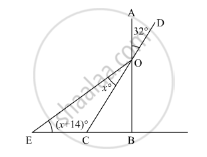
In the given figure, the value of x is ______.
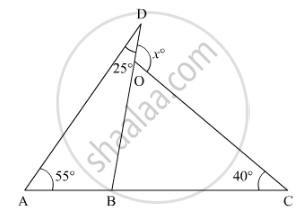
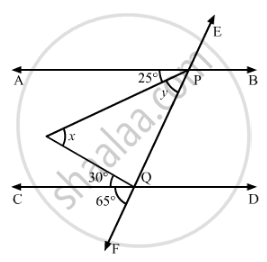
In the given figure, AB and CD are parallel lines and transversal EF intersects them at Pand Q respectively. If ∠APR = 25°, ∠RQC = 30° and ∠CQF = 65°, then
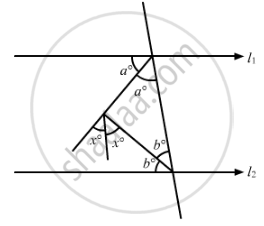
In the given figure, if l1 || l2, the value of x is
The angles of a right angled triangle are
In triangles ABC and PQR, AB = AC, ∠C = ∠P and ∠B = ∠Q. The two triangles are ______.
Find all the angles of an equilateral triangle.
Show that in a quadrilateral ABCD, AB + BC + CD + DA < 2(BD + AC)
