Advertisements
Advertisements
प्रश्न
Show that in a quadrilateral ABCD, AB + BC + CD + DA > AC + BD
Advertisements
उत्तर
Given in the question, a quadrilateral ABCD.
To proof that AB + BC + CD + DA > AC + BD.
Proof: In triangle ABC,
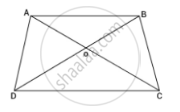
AB + BC > AC ...(i) [Sum of the lengths of any two sides of a triangle must be greater than the third side]
In triangle BCD,
BC + CD > BD ...(ii) [Sum of the lengths of any two sides of a triangle must be greater than the third side]
In triangle CDA,
CD + DA > AC ...(iii) [Sum of the lengths of any two sides of a triangle must be greater than the third side]
Similarly, in triangle DAB,
AD + AB > BD ...(iv) [Sum of the lengths of any two sides of a triangle must be greater than the third side]
Now, adding equation (i), (ii), (iii) and (iv), we get
AB + BC + BC + CD + CD + DA + AD + AB > AC + BD + AC + BD
2AB + 2BC + 2CD > 2AC + 2BD
2(AB + BC + CD + DA) > 2(AC + BD)
AB + BC + CD + DA > AC + BD
Hence proved.
APPEARS IN
संबंधित प्रश्न
In an isosceles triangle ABC, with AB = AC, the bisectors of ∠B and ∠C intersect each other at O. Join A to O. Show that:
- OB = OC
- AO bisects ∠A
If the base of an isosceles triangle is produced on both sides, prove that the exterior angles so formed are equal to each other.
In a ΔABC, if AB = AC and ∠B = 70°, find ∠A.
PQR is a triangle in which PQ = PR and S is any point on the side PQ. Through S, a line is drawn parallel to QR and intersecting PR at T. Prove that PS = PT.
ABC is a triangle in which ∠B = 2 ∠C. D is a point on BC such that AD bisects ∠BAC and AB = CD.
Prove that ∠BAC = 72°.
ABC is a triangle and D is the mid-point of BC. The perpendiculars from D to AB and AC are equal. Prove that the triangle is isosceles.
Fill the blank in the following so that the following statement is true.
In right triangles ABC and DEF, if hypotenuse AB = EF and side AC = DE, then ΔABC ≅ Δ ……
In ΔABC, if ∠A = 40° and ∠B = 60°. Determine the longest and shortest sides of the triangle.
If the angles A, B and C of ΔABC satisfy the relation B − A = C − B, then find the measure of ∠B.
In the given figure, if EC || AB, ∠ECD = 70° and ∠BDO = 20°, then ∠OBD is
If the measures of angles of a triangle are in the ratio of 3 : 4 : 5, what is the measure of the smallest angle of the triangle?
In the given figure, what is the value of x?
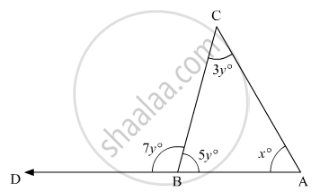
In the given figure, if BP || CQ and AC = BC, then the measure of x is
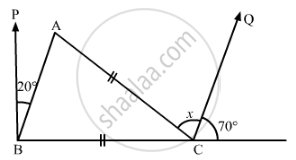
The base BC of triangle ABC is produced both ways and the measure of exterior angles formed are 94° and 126°. Then, ∠BAC =
Which of the following correctly describes the given triangle?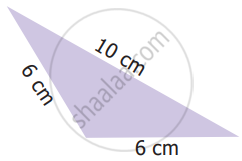
AD is a median of the triangle ABC. Is it true that AB + BC + CA > 2AD? Give reason for your answer.
In the following figure, D and E are points on side BC of a ∆ABC such that BD = CE and AD = AE. Show that ∆ABD ≅ ∆ACE.

Bisectors of the angles B and C of an isosceles triangle ABC with AB = AC intersect each other at O. Show that external angle adjacent to ∠ABC is equal to ∠BOC
Show that in a quadrilateral ABCD, AB + BC + CD + DA < 2(BD + AC)
