Advertisements
Advertisements
प्रश्न
ABC is a triangle and D is the mid-point of BC. The perpendiculars from D to AB and AC are equal. Prove that the triangle is isosceles.
Advertisements
उत्तर
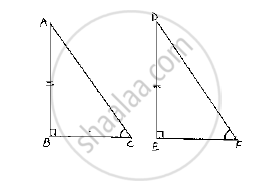
Given that, in two right triangles one side and acute angle of one are equal to the corresponding side and angle of the other
We have to prove that the triangles are congruent
Let us consider two right triangles such that
∠B=∠E=90° .................(1)
AB=DE ..................(2)
∠C=∠F ..................(3)
Now observe the two triangles ABC and DEF
∠C=∠F [From (3)]
∠B=∠E [From (4)]
and AB =DE [From (2)]
So, by AAS congruence criterion, we have
ΔABC≅ΔDEF
∴ The two triangles are congruent
Hence proved
APPEARS IN
संबंधित प्रश्न
In ΔABC, AD is the perpendicular bisector of BC (see the given figure). Show that ΔABC is an isosceles triangle in which AB = AC.

The vertical angle of an isosceles triangle is 100°. Find its base angles.
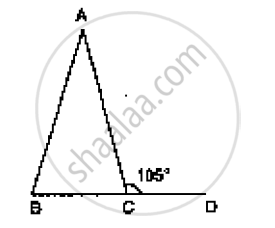
In Figure 10.24, AB = AC and ∠ACD =105°, find ∠BAC.
BD and CE are bisectors of ∠B and ∠C of an isosceles ΔABC with AB = AC. Prove that BD = CE.
PQR is a triangle in which PQ = PR and S is any point on the side PQ. Through S, a line is drawn parallel to QR and intersecting PR at T. Prove that PS = PT.
P is a point on the bisector of an angle ∠ABC. If the line through P parallel to AB meets BC at Q, prove that triangle BPQ is isosceles.
Angles A, B, C of a triangle ABC are equal to each other. Prove that ΔABC is equilateral.
Which of the following statements are true (T) and which are false (F):
The bisectors of two equal angles of a triangle are equal
Which of the following statements are true (T) and which are false (F):
The two altitudes corresponding to two equal sides of a triangle need not be equal.
Fill the blank in the following so that the following statement is true.
If altitudes CE and BF of a triangle ABC are equal, then AB = ....
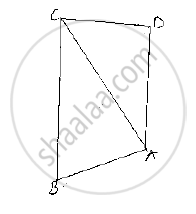
In Fig. 10.131, prove that: (i) CD + DA + AB + BC > 2AC (ii) CD + DA + AB > BC
Which of the following statements are true (T) and which are false (F)?
Sum of the three sides of a triangle is less than the sum of its three altitudes.
If the angles of a triangle are in the ratio 2 : 1 : 3, then find the measure of smallest angle.
In ΔABC, if ∠A = 100°, AD bisects ∠A and AD ⊥ BC. Then, ∠B =
In a ΔABC, ∠A = 50° and BC is produced to a point D. If the bisectors of ∠ABC and ∠ACDmeet at E, then ∠E =
In ∆ABC, AB = AC and ∠B = 50°. Then ∠C is equal to ______.
In ∆PQR, ∠P = 70° and ∠R = 30°. Which side of this triangle is the longest? Give reason for your answer.
M is a point on side BC of a triangle ABC such that AM is the bisector of ∠BAC. Is it true to say that perimeter of the triangle is greater than 2 AM? Give reason for your answer.
In the following figure, D and E are points on side BC of a ∆ABC such that BD = CE and AD = AE. Show that ∆ABD ≅ ∆ACE.

