Advertisements
Advertisements
प्रश्न
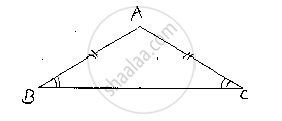
In an isosceles triangle, if the vertex angle is twice the sum of the base angles, calculate the angles of the triangle.
Advertisements
उत्तर
Let ΔABC be isosceles such that AB = AC
⇒∠B=∠C
Given that vertex angle A is twice the sum of the base angles B and C.
i.e., ∠A=2(∠B+∠C)
⇒∠A=2(∠B+∠B) [∵∠B=∠C]
⇒∠A=2(2∠B)
⇒∠A=4∠B
Now,
We know that sum of angles in a triangle 180°
⇒ ∠A+ ∠B+ ∠C=180°
4∠B+∠B+∠B=180° [∵∠A=4∠B and ∠B=∠C]
6∠B=180°
`∠B=(180°) /6=30° ` ∠B=30°
Since, ∠B=∠C⇒ ∠B=∠C=30°
And` ∠A=4∠B⇒ ∠A=4xx30°=120° `
∴Angles of the given triangle are 120°,30°,30°
APPEARS IN
संबंधित प्रश्न
In ΔABC, AD is the perpendicular bisector of BC (see the given figure). Show that ΔABC is an isosceles triangle in which AB = AC.

ABC is an isosceles triangle in which altitudes BE and CF are drawn to equal sides AC and AB respectively (see the given figure). Show that these altitudes are equal.

ΔABC is an isosceles triangle in which AB = AC. Side BA is produced to D such that AD = AB (see the given figure). Show that ∠BCD is a right angle.

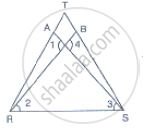
In Fig. 10.40, it is given that RT = TS, ∠1 = 2∠2 and ∠4 = 2∠3. Prove that ΔRBT ≅ ΔSAT
Prove that the medians of an equilateral triangle are equal.
Which of the following statements are true (T) and which are false (F):
The measure of each angle of an equilateral triangle is 60°
Which of the following statements are true (T) and which are false (F):
The bisectors of two equal angles of a triangle are equal
Fill the blank in the following so that the following statement is true.
Sides opposite to equal angles of a triangle are ......
Fill the blank in the following so that the following statement is true.
In a ΔABC if ∠A = ∠C , then AB = ......
In ΔABC, side AB is produced to D so that BD = BC. If ∠B = 60° and ∠A = 70°, prove that: (i) AD > CD (ii) AD > AC
Fill in the blank to make the following statement true.
Difference of any two sides of a triangle is........ than the third side.
Fill in the blank to make the following statement true.
If two sides of a triangle are unequal, then the larger side has .... angle opposite to it.
In the given figure, the sides BC, CA and AB of a Δ ABC have been produced to D, E and F respectively. If ∠ACD = 105° and ∠EAF = 45°, find all the angles of the Δ ABC.
In a triangle ABC, if AB = AC and AB is produced to D such that BD = BC, find ∠ACD: ∠ADC.
In ΔABC, if ∠A = 100°, AD bisects ∠A and AD ⊥ BC. Then, ∠B =
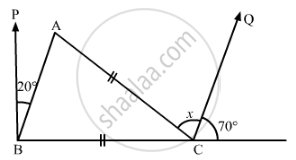
In the given figure, if BP || CQ and AC = BC, then the measure of x is
Which of the following correctly describes the given triangle?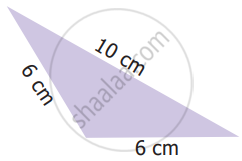
In ∆ABC, BC = AB and ∠B = 80°. Then ∠A is equal to ______.
In ∆PQR, if ∠R > ∠Q, then ______.
ABC is an isosceles triangle with AB = AC and D is a point on BC such that AD ⊥ BC (Figure). To prove that ∠BAD = ∠CAD, a student proceeded as follows:
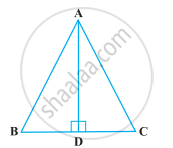
In ∆ABD and ∆ACD,
AB = AC (Given)
∠B = ∠C (Because AB = AC)
and ∠ADB = ∠ADC
Therefore, ∆ABD ≅ ∆ACD (AAS)
So, ∠BAD = ∠CAD (CPCT)
What is the defect in the above arguments?
[Hint: Recall how ∠B = ∠C is proved when AB = AC].
