Advertisements
Advertisements
Question
Which of the following statements are true (T) and which are false (F):
The bisectors of two equal angles of a triangle are equal
Advertisements
Solution
True (T)
Reason: Since it an isosceles triangle, the lengths of bisectors of the two equal angles are equal
APPEARS IN
RELATED QUESTIONS
ΔABC is an isosceles triangle in which AB = AC. Side BA is produced to D such that AD = AB (see the given figure). Show that ∠BCD is a right angle.

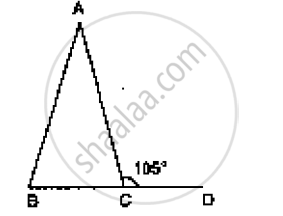
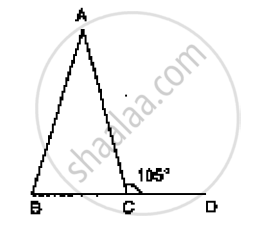
In Figure AB = AC and ∠ACD =105°, find ∠BAC.
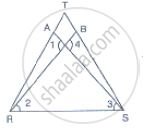
In Fig. 10.40, it is given that RT = TS, ∠1 = 2∠2 and ∠4 = 2∠3. Prove that ΔRBT ≅ ΔSAT
In a ΔABC, if AB = AC and ∠B = 70°, find ∠A.
In Figure 10.24, AB = AC and ∠ACD =105°, find ∠BAC.
PQR is a triangle in which PQ = PR and S is any point on the side PQ. Through S, a line is drawn parallel to QR and intersecting PR at T. Prove that PS = PT.
In a ΔPQR, if PQ = QR and L, M and N are the mid-points of the sides PQ, QR and RP
respectively. Prove that LN = MN.
Which of the following statements are true (T) and which are false (F):
If the bisector of the vertical angle of a triangle bisects the base, then the triangle may be isosceles.
Fill the blank in the following so that the following statement is true.
Angle opposite to equal sides of a triangle are .....
Fill the blank in the following so that the following statement is true.
In right triangles ABC and DEF, if hypotenuse AB = EF and side AC = DE, then ΔABC ≅ Δ ……
Is it possible to draw a triangle with sides of length 2 cm, 3 cm and 7 cm?
Which of the following statements are true (T) and which are false (F)?
Of all the line segments that can be drawn from a point to a line not containing it, the perpendicular line segment is the shortest one.
Fill in the blank to make the following statement true.
In a right triangle the hypotenuse is the .... side.
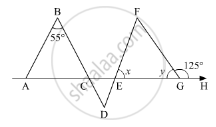
In the given figure, if AB || DE and BD || FG such that ∠FGH = 125° and ∠B = 55°, find x and y.
Line segments AB and CD intersect at O such that AC || DB. If ∠CAB = 45° and ∠CDB = 55°, then ∠BOD =
In the given figure, for which value of x is l1 || l2?
If ∆PQR ≅ ∆EDF, then is it true to say that PR = EF? Give reason for your answer
CDE is an equilateral triangle formed on a side CD of a square ABCD (Figure). Show that ∆ADE ≅ ∆BCE.

Show that in a quadrilateral ABCD, AB + BC + CD + DA < 2(BD + AC)
