Advertisements
Advertisements
प्रश्न
CDE is an equilateral triangle formed on a side CD of a square ABCD (Figure). Show that ∆ADE ≅ ∆BCE.

Advertisements
उत्तर
Given in figure triangle CDE is an equilateral triangle formed on a side CD of a square ABCD.
To proof that ΔADE ≅ ∆BCE
Proof: In triangle ADE and triangle BCE,
DE = CE ...[Side of an equilateral triangle]
∠ADE = ∠BCE
∠ADC = ∠BCD = 90° and ∠EDC = ∠ECD = 60°
∠ADE = 90° + 60° = 150° and ∠BCE = 90° + 60° = 150°
AD = BC ...[Sides of a square]
∆ADE ≅ ∆BCE ...[By SAS congruence rule]
APPEARS IN
संबंधित प्रश्न
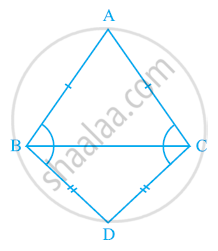
ABC and DBC are two isosceles triangles on the same base BC (see the given figure). Show that ∠ABD = ∠ACD.
In a ΔABC, it is given that AB = AC and the bisectors of ∠B and ∠C intersect at O. If M is a point on BO produced, prove that ∠MOC = ∠ABC.
ABC is a triangle in which ∠B = 2 ∠C. D is a point on BC such that AD bisects ∠BAC and AB = CD.
Prove that ∠BAC = 72°.
Which of the following statements are true (T) and which are false (F):
Sides opposite to equal angles of a triangle may be unequal
Which of the following statements are true (T) and which are false (F) :
If the altitude from one vertex of a triangle bisects the opposite side, then the triangle may be isosceles.
Which of the following statements are true (T) and which are false (F):
If the bisector of the vertical angle of a triangle bisects the base, then the triangle may be isosceles.
In ΔABC, if ∠A = 40° and ∠B = 60°. Determine the longest and shortest sides of the triangle.
If the angles of a triangle are in the ratio 2 : 1 : 3, then find the measure of smallest angle.
If the angles A, B and C of ΔABC satisfy the relation B − A = C − B, then find the measure of ∠B.
In ΔABC, if ∠A = 100°, AD bisects ∠A and AD ⊥ BC. Then, ∠B =
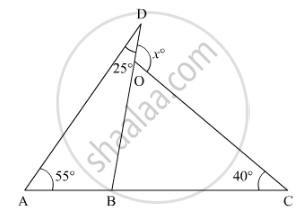
In the given figure, the value of x is ______.
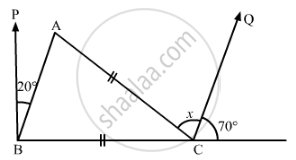
In the given figure, if BP || CQ and AC = BC, then the measure of x is
If the bisectors of the acute angles of a right triangle meet at O, then the angle at Obetween the two bisectors is
Which of the following correctly describes the given triangle?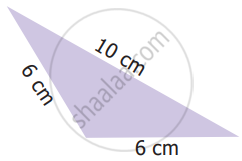
If ∆PQR ≅ ∆EDF, then is it true to say that PR = EF? Give reason for your answer
Is it possible to construct a triangle with lengths of its sides as 9 cm, 7 cm and 17 cm? Give reason for your answer.
In the following figure, D and E are points on side BC of a ∆ABC such that BD = CE and AD = AE. Show that ∆ABD ≅ ∆ACE.

