Advertisements
Advertisements
प्रश्न
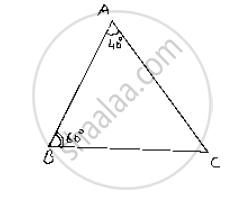
In ΔABC, if ∠A = 40° and ∠B = 60°. Determine the longest and shortest sides of the triangle.
Advertisements
उत्तर
Given that in , ΔABC ∠A =40° and ∠B=60° We have to find longest and shortest side We know that,
Sum of angles in a triangle180°
⇒∠A+∠B+∠C=180°
⇒40°+60°+∠C=180°
⇒∠C=180° -(40° +60° )
=180° -100° =80°
∴∠C = 80°
Now,
⇒ 40<60<80⇒∠A< ∠B < ∠C
⇒ ∠Cis greater angle and ∠A is smaller angle
Now, ∠A<∠B<∠C
⇒ BC<AAC<AB
[∵Side opposite to greater angle is larger and side opposite to smaller angle is smaller]
∴ AB is longest and BC is smallest or shortest side.
APPEARS IN
संबंधित प्रश्न
Find the measure of each exterior angle of an equilateral triangle.
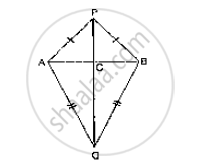
AB is a line seg P and Q are points on opposite sides of AB such that each of them is equidistant from the points A and B (See Fig. 10.26). Show that the line PQ is perpendicular bisector of AB.
Find the measure of each exterior angle of an equilateral triangle.
BD and CE are bisectors of ∠B and ∠C of an isosceles ΔABC with AB = AC. Prove that BD = CE.
ABC is a triangle in which ∠B = 2 ∠C. D is a point on BC such that AD bisects ∠BAC and AB = CD.
Prove that ∠BAC = 72°.
Which of the following statements are true (T) and which are false (F):
Sides opposite to equal angles of a triangle may be unequal
Prove that the perimeter of a triangle is greater than the sum of its altitudes.
In the given figure, the sides BC, CA and AB of a Δ ABC have been produced to D, E and F respectively. If ∠ACD = 105° and ∠EAF = 45°, find all the angles of the Δ ABC.
ABC is a triangle. The bisector of the exterior angle at B and the bisector of ∠C intersect each other at D. Prove that ∠D = \[\frac{1}{2}\] ∠A.
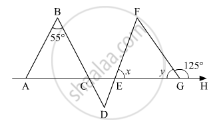
In the given figure, if AB || DE and BD || FG such that ∠FGH = 125° and ∠B = 55°, find x and y.
Line segments AB and CD intersect at O such that AC || DB. If ∠CAB = 45° and ∠CDB = 55°, then ∠BOD =
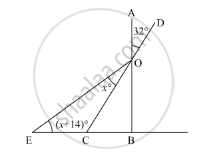
In the given figure, if AB ⊥ BC. then x =
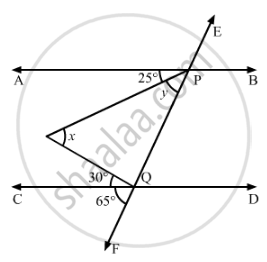
In the given figure, AB and CD are parallel lines and transversal EF intersects them at Pand Q respectively. If ∠APR = 25°, ∠RQC = 30° and ∠CQF = 65°, then
In a ΔABC, ∠A = 50° and BC is produced to a point D. If the bisectors of ∠ABC and ∠ACDmeet at E, then ∠E =
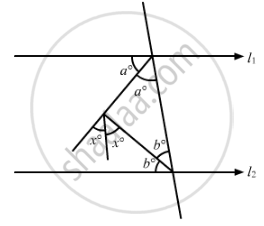
In the given figure, if l1 || l2, the value of x is
The angles of a right angled triangle are
D is a point on the side BC of a ∆ABC such that AD bisects ∠BAC. Then ______.
In the following figure, D and E are points on side BC of a ∆ABC such that BD = CE and AD = AE. Show that ∆ABD ≅ ∆ACE.

ABC is an isosceles triangle with AB = AC and D is a point on BC such that AD ⊥ BC (Figure). To prove that ∠BAD = ∠CAD, a student proceeded as follows:
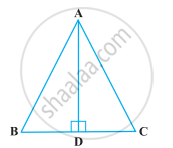
In ∆ABD and ∆ACD,
AB = AC (Given)
∠B = ∠C (Because AB = AC)
and ∠ADB = ∠ADC
Therefore, ∆ABD ≅ ∆ACD (AAS)
So, ∠BAD = ∠CAD (CPCT)
What is the defect in the above arguments?
[Hint: Recall how ∠B = ∠C is proved when AB = AC].
