Topics
Integers
- Natural Numbers
- Whole Numbers
- Negative and Positive Numbers
- Integers
- Representation of Integers on the Number Line
- Ordering of Integers
- Addition of Integers
- Subtraction of Integers
- Properties of Addition and Subtraction of Integers
- Multiplication of a Positive and a Negative Integers
- Multiplication of Two Negative Integers
- Product of Three Or More Negative Integers
- Closure Property of Multiplication of Integers
- Commutative Property of Multiplication of Integers
- Multiplication of Integers with Zero
- Multiplicative Identity of Integers
- Associative Property of Multiplication of Integers
- Distributive Property of Multiplication of Integers
- Making Multiplication Easier of Integers
- Division of Integers
- Properties of Division of Integers
Part 1
Large Numbers Around Us
Arithmetic Expressions
Fractions and Decimals
- Concept of Fraction
- Types of Fractions
- Concept of Proper and Improper Fractions
- Concept of Mixed Fractions
- Concept of Equivalent Fractions
- Like and Unlike Fraction
- Comparing Fractions
- Addition of Fraction
- Subtraction of Fraction
- Multiplication of a Fraction by a Whole Number
- Using Operator 'Of' with Multiplication and Division
- Multiplication of Fraction
- Division of Fractions
- Concept of Reciprocals or Multiplicative Inverses
- Problems Based on Fraction
- The Decimal Number System
- Comparing Decimal Numbers
- Addition of Decimal Fraction
- Subtraction of Decimal Numbers
- Multiplication of Decimal Numbers
- Division of Decimal Numbers
- Problems Based on Decimal Numbers
Part 2
A Peek Beyond the Point
Data Handling
Simple Equations
Expressions using Letter-Numbers
Lines and Angles
Parallel and Intersecting Lines
Number Play
The Triangle and Its Properties
- Basic Concepts of Triangles
- Classification of Triangles based on Sides
- Classification of Triangles based on Angles
- Median of a Triangle
- Altitudes of a Triangle
- Exterior Angle of a Triangle and Its Property
- Some Special Types of Triangles - Equilateral and Isosceles Triangles
- Basic Properties of a Triangle
- Right-angled Triangles and Pythagoras Property
A Tale of Three Intersecting Lines
Comparing Quantities
- Ratio
- Concept of Equivalent Ratios
- Proportion
- Unitary Method
- Basic Concept of Percentage
- Estimation in Percentages
- Interpreting Percentages
- Conversion between Percentage and Fraction or Decimal
- Ratios to Percents
- Increase Or Decrease as Percent
- Basic Concepts of Profit and Loss
- Profit or Loss as a Percentage
- Calculation of Interest
Congruence of Triangles
- Similarity and Congruency of Figures
- Congruence Among Line Segments
- Congruence of Angles
- Congruence of Triangles
- Criteria for Congruence of Triangles
- Criteria for Similarity of Triangles
- SAS Congruence Criterion
- ASA Congruence Criterion
- RHS Congruence Criterion
- Exceptional Criteria for Congruence of Triangles
Working with Fractions
Rational Numbers
- Rational Numbers
- Equivalent Rational Number
- Positive and Negative Rational Numbers
- Rational Numbers on a Number Line
- Rational Numbers in Standard Form
- Comparison of Rational Numbers
- Rational Numbers Between Two Rational Numbers
- Addition of Rational Number
- Subtraction of Rational Number
- Multiplication of Rational Numbers
- Division of Rational Numbers
Perimeter and Area
- Basic Concepts in Mensuration
- Concept of Perimeter
- Perimeter of a Rectangle
- Perimeter of Squares
- Perimeter of Triangle
- Perimeter of Polygon
- Concept of Area
- Area of Square
- Area of Rectangle
- Triangles as Parts of Rectangles and Square
- Generalising for Other Congruent Parts of Rectangles
- Area of a Parallelogram
- Area of a Triangle
- Circumference of a Circle
- Area of Circle
- Conversion of Units
- Problems based on Perimeter
- Problems based on Area
Geometric Twins
Operations with Integers
Algebraic Expressions
Practical Geometry
- Construction of a Line Parallel to a Given Line, Through a Point Not on the Line
- Construction of Triangles
- Constructing a Triangle When the Length of Its Three Sides Are Known (SSS Criterion)
- Constructing a Triangle When the Lengths of Two Sides and the Measure of the Angle Between Them Are Known. (SAS Criterion)
- Constructing a Triangle When the Measures of Two of Its Angles and the Length of the Side Included Between Them is Given. (ASA Criterion)
- Constructing a Right-angled Triangle When the Length of One Leg and Its Hypotenuse Are Given (RHS Criterion)
Exponents and Powers
- Concept of Exponents
- Multiplying Powers with the Same Base
- Dividing Powers with the Same Base
- Taking Power of a Power
- Multiplying Powers with Different Base and Same Exponents
- Dividing Powers with Different Base and Same Exponents
- Numbers with Exponent Zero, One, Negative Exponents
- Miscellaneous Examples Using the Laws of Exponents
- Decimal Number System Using Exponents and Powers
- Crores
Finding Common Ground
Symmetry
Another Peek Beyond the Point
Connecting the Dots
Visualizing Solid Shapes
Constructions and Tilings
Finding the Unknown
- Rules for Addition of Integers
- Real-Life Applications
- Activity
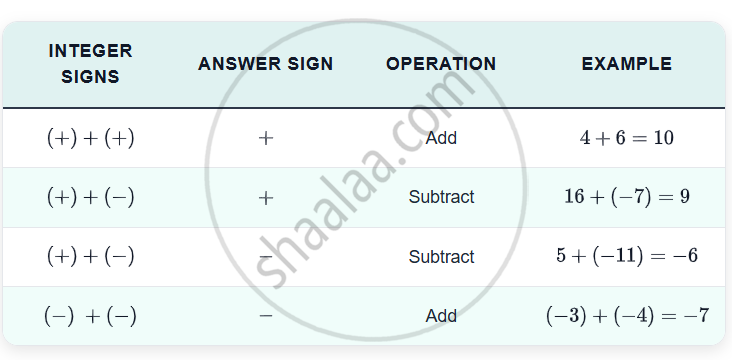
Rules for Addition of Integers
Rule 1: Both integers are positive
- Add them normally.
- The result is positive.
Example: (+3) + (+2) = +5
Rule 2: Both integers are negative
- Add their magnitudes.
- The result is negative.
Example: (-12) + (-67) = -79
Rule 3: One positive, one negative
- Subtract the smaller number from the larger one (ignore signs).
- The result takes the sign of the number with the larger magnitude.
Example: (-38) + 72 = 34
Conversely, (-72) + 38 = -34
Real-Life Applications
Temperature Changes
Scenario: The morning temperature is -3°C. During the day, it rises by 8°C.
Calculation: (-3) + (+8) = +5
Answer: The final temperature is +5°C.
Bank Account Transactions
Scenario: You have ₹200 in your account. You withdraw ₹150.
Calculation: (+200) + (-150) = +50
Answer: Your remaining balance is ₹50.
Elevator Movements
Scenario: You start on the 2nd floor and go down 5 floors.
Calculation: (+2) + (-5) = -3
Answer: You end up on the 3rd basement level.
Activity
Representation of the Rabbit’s Hops on a Number Line Using Positive and Negative Signs:
1. For Positive signs
- At first the rabbit was at the number
- It hopped 5 units to the right.
- The number is currently at +6.
Calculation:
1 + 5 = (+1) + (+5) = +6 2. For Negative Signs
- Initially, the rabbit was positioned at number -2.
- It hopped 5 units to the right.
- It is now at the number +3.

Calculation:
(-2) + (+5) = +3
Example Question 1
Find the sum of (- 11) + ( + 4) + (- 9) + (+ 7)
(- 11) + ( + 4) + (- 9) + (+ 7)
= (- 11) + (- 9) + ( + 4) + (+ 7)
= (- 20) + (+ 11)
= - 9.
Example Question 2
Add without using number line: (+ 10) + (+ 3) + (- 8) + (- 9).
(+ 10) + (+ 3) + (- 8) + (- 9).
= (+ 13) + (- 17)
= - 4.
