Topics
Number System (Including Estimation and Approximation)
Theme 1 : Numbers
Number System(Consolidating the Sense of Numberness)
Number System
Numbers in Indian and International Systems (With Comparison)
Estimation
Theme 2 : Ratio, Proportion and Arithmetic Problems
Ratio and Proportion
Algebra
Natural Numbers and Whole Numbers (Including Number Line and Patterns)
Theme 3 : Algebra
Numbers in India and International System (With Comparison)
Theme 4 : Geometry
Negative Numbers and Integers
Place Value
Geometry
Mensuration
Natural Numbers and Whole Numbers (Including Patterns)
Theme 5 : Mensuration
Sets
Data Handling
Negative Numbers and Integers
Fractions
Theme 6 : Statistics
Decimal Fractions
Number Line
HCF and LCM
Playing with Numbers (Including H.C.F. and L.C.M.)
Ratio and Proportion (Including Unitary Method)
Playing with Numbers
- Simplification of Brackets
- Finding Factors Using Rectangular Arrangements and Division
- Factors and Common Factors
- Multiples and Common Multiples
- Concept of Even and Odd Number
- Tests for Divisibility of Numbers
- Divisibility by 2
- Divisibility by 4
- Divisibility by 8
- Divisibility by 3
- Divisibility by 6
- Divisibility by 9
- Divisibility by 5
- Divisibility by 11
Sets
Percent (Percentage)
Ratio
Idea of Speed, Distance and Time
Fundamental Concepts (With operations on Algebraic Expressions)
Proportion (Including Word Problems)
Framing Algebraic Expressions (Including Substitution and Linear Equations)
Unitary Method
Fractions
- Concept of Fraction
- Types of Fractions
- Concept of Proper and Improper Fractions
- Concept of Mixed Fractions
- Like and Unlike Fraction
- Concept of Equivalent Fractions
- Conversion between Improper and Mixed fraction
- Conversion between Unlike and Like Fractions
- Simplest Form of a Fractions
- Comparing Fractions
- Addition of Fraction
- Subtraction of Fraction
- Multiplication of Fraction
- Division of Fractions
- Using Operator 'Of' with Multiplication and Division
- BODMAS Rule
- Problems Based on Fraction
Fundamental Concepts (Including Angles and their Properties)
Triangles (Including Types and Properties of Triangles)
Decimal Fractions
Percent (Percentage)
Quadrilaterals
Idea of Speed, Distance and Time
Circles
Constructions
Symmetry
Fundamental Concepts
Fundamental Operations (Related to Algebraic Expressions)
Recognition of Solids
Substitution (Including Use of Brackets as Grouping Symbols)
Perimeter and Area of Plane Figures
Framing Algebraic Expressions (Including Evaluation)
Data Handling (Including Mean and Median)
Simple (Linear) Equations (Including Word Problems)
Fundamental Concepts
Angles (With Their Types)
Properties of Angles and Lines (Including Parallel Lines)
Triangles (Including Types, Properties and Constructions)
Quadrilateral
Polygons
The Circle
Symmetry (Including Constructions on Symmetry)
Recognition of Solids
Perimeter and Area of Plane Figures
Data Handling (Including Pictograph and Bar Graph)
Mean and Median
- Step-by-Step Process for Addition
- Examples of Addition
- Step-by-Step Process for Subtraction
- Examples of Subtraction
- Step-by-Step Process for Multiplication
- Examples of Multiplication
- Step-by-Step Process for Division
- Examples of Division
- Key Points Summary
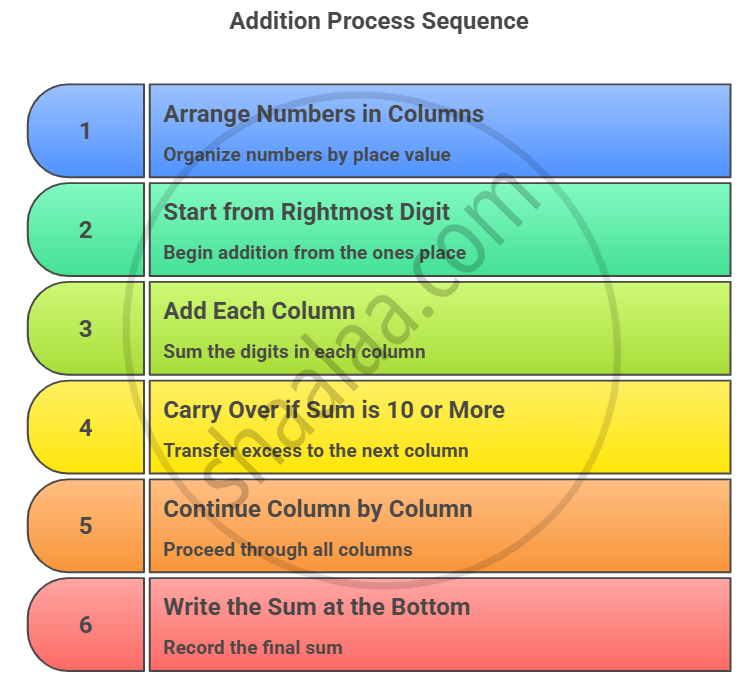
Step-by-Step Process for Addition
Examples of Addition
Example 1:
If A = 48,497, B = 7,328, and C = 1,33,224.
Find:
(i) A + B
4 8, 4 9 7
+ 7, 3 2 8
5 5, 8 2 5
(ii) B + C
7, 3 2 8
+ 1,3 3, 2 2 4
1, 4 0, 5 5 2
Example 2:
The weight of one bag of wheat is 98 kg 450 g and the weight of another bag of wheat is 106 kg 928 g. What is the total weight of both the bags?
Solution:
Weight of one bag of wheat = 98 kg 450 g
and, weight of another bag of wheat = 106 kg 928 g
∴ Total weight of both the bags = 204 kg 1378 g
Since 1378 g = 1 kg 378 g
Therefore, the total weight of both bags = 205 kg 378 g
Example 3:
Three different tanks contain 54,937 liters, 49,328 liters, and 1,07,244 litre of water.
What is the total quantity of water in the three tanks?
Solution:
Water in one tank = 54,937 liters.
water in another tank = 49,328 liters
water in third tank = 1,07,244 litre
∴Water In all the three tanks = 2, 11 ,509 litre
Step-by-Step Process for Subtraction

Examples of Subtraction
Example 1:
If A = 48,497, B = 7,328, and C = 1,33,224.
Find:
(i) C – A
1, 3 3, 2 2 4
– 4 8, 4 9 7
8 4, 7 2 7
Example 2:
The sales receipt of a company during a certain year was ₹ 8,73,540. In the following year, it was decreased by ₹ 84,670. What was the sales receipt of the company during the second year?
Solution:
The sale receipt of the company during second year
= ₹ 8,73,540 – ₹ 84,670 = ₹ 8,73,540
8, 7 3, 5 4 0
− 8 4, 7 2 7
7, 8 8, 8 7 0
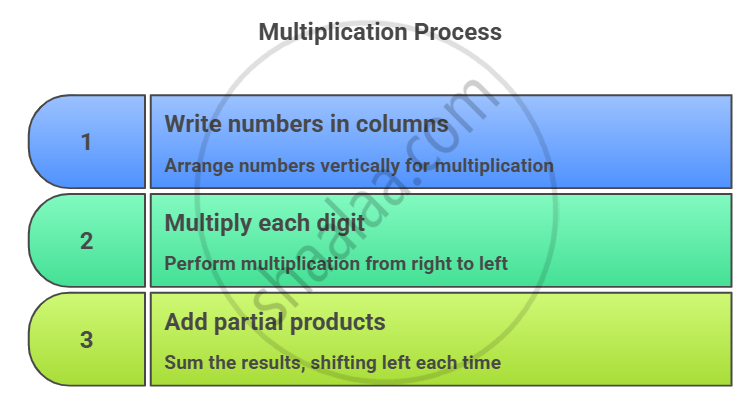
Step-by-Step Process for Multiplication
Examples of Multiplication
Example 1:
The Cost of one article is ₹57,390. What will be the cost of 275 such articles
Solution:
Cost of one article = ₹ 57,390
Cost of 275 such articles = 275 × ₹57,390 = ₹1,57,82,250
Example 2:
In an examination, a student multiplied 40,327 by 46 instead of 64. By how much was his answer greater than or less than the correct answer?
Solution:
The student's answer = 40,327 × 46
= 40,327
× 46
241962
+ 161308
18,55,042
Correct answer = 40,327 × 64
= 40,327
× 64
161308
+ 241962
25,80,928
The incorrect answer is less than the correct answer
by 25,80,928 − 18,55,042 = 25,80,928
− 18,55,042
7,25,886
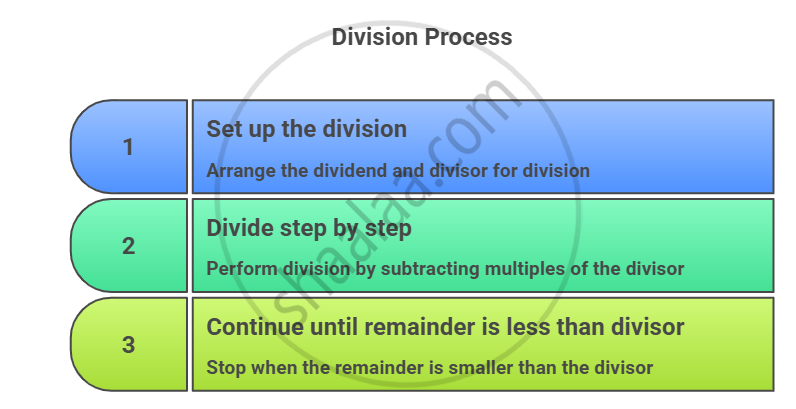
Step-by-Step Process for Division
Examples of Division
₹ 82,804 is divided equally among 326 pupils. How much will each get?
254
`326")"overline(82804)`
– 652 (326 × 2)
1760
– 1630 (326 × 5)
1304
– 1304 (326 × 4)
×
Each will get ₹ 82,804 ÷ 326 = ₹ 254
Key Points Summary
-
Align digits by place value for all operations.
-
Carry over and borrow carefully in addition and subtraction.
-
Check multiplication and division with estimation or reverse calculation.
-
Always interpret answers in context (e.g., convert grams to kilograms if needed).
