Topics
Number System (Including Estimation and Approximation)
Theme 1 : Numbers
Number System(Consolidating the Sense of Numberness)
Number System
Ratio and Proportion
Numbers in Indian and International Systems (With Comparison)
Theme 2 : Ratio, Proportion and Arithmetic Problems
Estimation
Numbers in India and International System (With Comparison)
Natural Numbers and Whole Numbers (Including Number Line and Patterns)
Theme 3 : Algebra
Algebra
Theme 4 : Geometry
Negative Numbers and Integers
Place Value
Geometry
Natural Numbers and Whole Numbers (Including Patterns)
Mensuration
Theme 5 : Mensuration
Sets
Theme 6 : Statistics
Fractions
Negative Numbers and Integers
Data Handling
Decimal Fractions
Number Line
HCF and LCM
Playing with Numbers (Including H.C.F. and L.C.M.)
Ratio and Proportion (Including Unitary Method)
Playing with Numbers
- Simplification of Brackets
- Finding Factors Using Rectangular Arrangements and Division
- Factors and Common Factors
- Multiples and Common Multiples
- Concept of Even and Odd Number
- Tests for Divisibility of Numbers
- Divisibility by 2
- Divisibility by 4
- Divisibility by 8
- Divisibility by 3
- Divisibility by 6
- Divisibility by 9
- Divisibility by 5
- Divisibility by 11
Percent (Percentage)
Sets
Idea of Speed, Distance and Time
Ratio
Fundamental Concepts (With operations on Algebraic Expressions)
Proportion (Including Word Problems)
Unitary Method
Framing Algebraic Expressions (Including Substitution and Linear Equations)
Fractions
- Concept of Fraction
- Types of Fractions
- Concept of Proper and Improper Fractions
- Concept of Mixed Fractions
- Like and Unlike Fraction
- Concept of Equivalent Fractions
- Conversion between Improper and Mixed fraction
- Conversion between Unlike and Like Fractions
- Simplest Form of a Fractions
- Comparing Fractions
- Addition of Fraction
- Subtraction of Fraction
- Multiplication of Fraction
- Division of Fractions
- Using Operator 'Of' with Multiplication and Division
- BODMAS Rule
- Problems Based on Fraction
Fundamental Concepts (Including Angles and their Properties)
Triangles (Including Types and Properties of Triangles)
Decimal Fractions
Quadrilaterals
Percent (Percentage)
Idea of Speed, Distance and Time
Circles
Fundamental Concepts
Constructions
Symmetry
Fundamental Operations (Related to Algebraic Expressions)
Recognition of Solids
Substitution (Including Use of Brackets as Grouping Symbols)
Framing Algebraic Expressions (Including Evaluation)
Perimeter and Area of Plane Figures
Simple (Linear) Equations (Including Word Problems)
Data Handling (Including Mean and Median)
Fundamental Concepts
Angles (With Their Types)
Properties of Angles and Lines (Including Parallel Lines)
Triangles (Including Types, Properties and Constructions)
Quadrilateral
Polygons
The Circle
Symmetry (Including Constructions on Symmetry)
Recognition of Solids
Perimeter and Area of Plane Figures
Data Handling (Including Pictograph and Bar Graph)
Mean and Median
- Introduction
- Matchstick Pattern Rule
- Examples
- Key points Summary
CISCE: Class 6
Introduction
A matchstick pattern is a way of building shapes using matchsticks, where each new figure follows a specific rule.
In this topic, we learn how to create connected squares and find out exactly how many matchsticks we need for any figure number.
CISCE: Class 6
Matchstick Pattern Rule
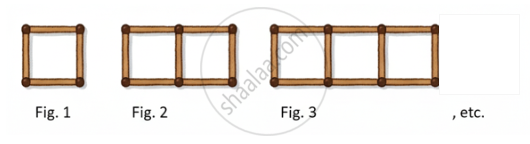
Step-by-step derivation:
- The first figure has 4 matchsticks.
- Each new figure adds 3 matchsticks.
- For figure number n: M = 4 + 3 × (n − 1)
- Let's simplify: M = 4 + 3n − 3 = 3n + 1
| Figure Number (n) | Number of Matchsticks(M) |
|---|---|
| 1 | 4 |
| 2 | 7 |
| 3 | 10 |
| 4 | 13 |
Therefore, our formula is
M = 3n + 1
Where: M = total matchsticks, n = figure number
CISCE: Class 6
Examples
1. For the 10th figure:
-
M = 3n + 1
-
M = 3 × 10 + 1
= 31 matchsticks
2. For the 100th figure:
- M = 3n + 1
- M = 3 × 100 + 1
= 301 matchsticks
3. Which figure needs 25 matchsticks?
- 25 = 3n + 1
- 24 = 3n
- n = 8, so it's Figure 8
CISCE: Class 6
Key Points Summary
| Pattern Type | Matchstick Pattern (Connected Squares) |
|---|---|
| Formula | M = 3n + 1 |
| First Term | 4 matchsticks |
| Common Difference | 3 matchsticks |
| Sequence Type | Arithmetic Sequence |
| Key Concept | Sharing sides saves matchsticks |
