Topics
Orienting Yourself: The Use of Coordinates
Number Systems
Number Systems
Part 1
Introduction to Polynomials
Introduction to Linear Polynomials
Part 2
Algebra
Algebraic Expressions
Algebraic Identities
Coordinate Geometry
The World of Numbers
Sequences and Progressions
Geometry
Exploring Algebraic Identities
Exploring Algebraic Identities
Area
Constructions
- Introduction of Constructions
- Geometric Constructions
- Some Constructions of Triangles
I’m Up and Down, and Round and Round
Mensuration
Linear Equations in Two Variables
Statistics and Probability
Measuring Space: Perimeter and Area
Coordinate Geometry
Probability
Introduction to Euclid’s Geometry: Axioms and Postulates
The Mathematics of Maybe: Introduction to Probability
Lines and Angles
- Introduction to Lines and Angles
- Basic Terms and Definitions
- Intersecting Lines and Non-intersecting Lines
- Parallel Lines
- Concept of Pairs of Angles
- Concept of Transversal Lines
- Basic Properties of a Triangle
Predicting What Comes Next: Exploring Sequences
Triangles: Congruence Theorems
4-gons (Quadrilaterals)
- Properties of Quadrilateral
- Another Condition for a Quadrilateral to Be a Parallelogram
- Theorem of Midpoints of Two Sides of a Triangle
- Property: The Opposite Sides of a Parallelogram Are of Equal Length.
- Theorem: A Diagonal of a Parallelogram Divides It into Two Congruent Triangles.
- Theorem : If Each Pair of Opposite Sides of a Quadrilateral is Equal, Then It is a Parallelogram.
- Property: The Opposite Angles of a Parallelogram Are of Equal Measure.
- Theorem: If in a Quadrilateral, Each Pair of Opposite Angles is Equal, Then It is a Parallelogram.
- Property: The diagonals of a parallelogram bisect each other. (at the point of their intersection)
- Theorem : If the Diagonals of a Quadrilateral Bisect Each Other, Then It is a Parallelogram
Circles
Area and Perimeter
- Area of a Triangle by Heron's Formula
- Application of Heron’s Formula in Finding Areas of Quadrilaterals
- Geometric Interpretation of the Area of a Triangle
Surface Area and Volume
Statistics
Introduction to Probability
- Introduction
- Adjacent Angles
- Vertically Opposite Angles
- Congruent Angles
- Complementary Angles
- Supplementary Angles
- Example 1
- Example 2
- Key Points Summary
Introduction
Angles describe the space between two rays sharing a common endpoint. Understanding different angle types and their properties helps in geometry, engineering, and everyday tasks like measuring turns or building layouts.
Adjacent Angles
Two angles are considered adjacent if they satisfy three specific conditions:
-
They share a common vertex.
-
They share a common arm.
-
Their other arms lie on opposite sides of the common arm.
Example: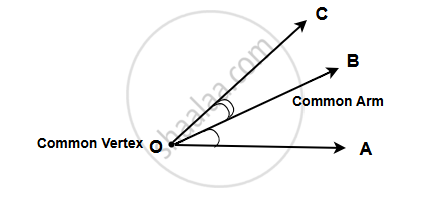
In ∠AOB and ∠BOC, OB is the common arm and O the common vertex.
∴ ∠AOB and ∠BOC are adjacent angles.
Vertically Opposite Angles
Definition: When two straight lines intersect, they form two pairs of opposite angles whose sides form vertical pairs.
Property: Vertically opposite angles are equal in measure.
Example:
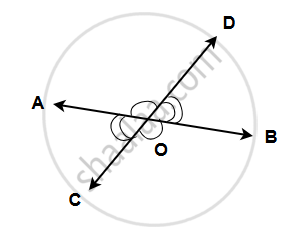
Lines AB and CD cross at O; then ∠AOC = ∠BOD and ∠AOD = ∠BOC.
Congruent Angles
Angles that have the same measure are called congruent angles.
Example:
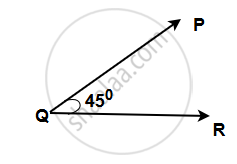
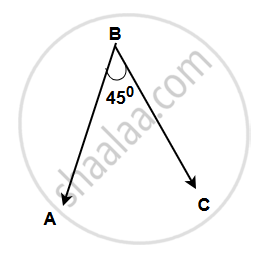
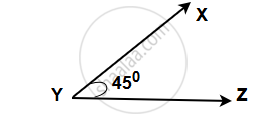
Angles PQR, ABC and XYZ are congruent since these angles have the same measure, i.e., 45°.
Complementary Angles
Definition: Two angles whose sum is 90°. Each angle is the complement of the other.
Calculation: Complement of θ = 90° – θ.
Example:
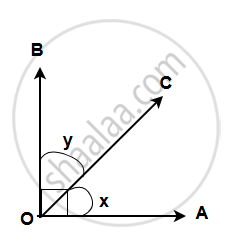
If x + y = 90°
Then:
-
x is the complement of y
-
y is the complement of x
Supplementary Angles
Definition: Two angles are supplementary if their sum is 180°.
Each is the supplement of the other.
Example:
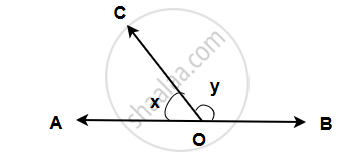
On a straight line, angle x + angle y = 180°, so they are supplementary.
Example 1
Find the complement of each given angle: (i) 35° (ii) `2/3` of 90°
Solution:
(i) Complement of 35° = 90° − 35° = 55°
(ii) Since `2/3` of 90° = `2/3` × 90° = 60°,
∴ Its complement = 90° − 60° = 30°.
Example 2
Two supplementary angles are in the ratio 5:4. Find the angles.
Solution:
The ratio of the supplementary angles is 5 : 4, and 5 + 4 = 9.
∴ The angles are `5/9` × 180° and `4/9` × 180°
= 100° and 80°, respectively
Alternative method:
Let the angles be 5x and 4x. [As ratio of the angles is 5:4]
Since sum of supplementary angles = 180°
==> 5x + 4x = 180°
==> 9x = 180° and x = 20°
∴ Required angles = 5x and 4x
= 5 × 20° and 4 × 20°
= 100° and 80°
Key Points Summary
-
Adjacent angles share one arm.
-
Vertically opposite angles formed by intersecting lines are always equal.
-
Complementary angles sum to 90°; supplementary to 180°.
-
Angles on a straight line add up to 180°; around a point to 360°.
-
Always subtract from the total (90°, 180°, or 360°) to find complements, supplements, or missing angles.
Example Question 1
In the given figure, Identify two pairs of vertically opposite angles.
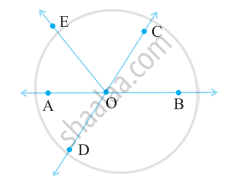
Vertically opposite angles are: (∠COB, ∠AOD), and (∠AOC, ∠BOD)