Topics
Orienting Yourself: The Use of Coordinates
Number Systems
Number Systems
Part 1
Introduction to Polynomials
Introduction to Linear Polynomials
Part 2
Algebra
Algebraic Expressions
Algebraic Identities
Coordinate Geometry
The World of Numbers
Sequences and Progressions
Geometry
Exploring Algebraic Identities
Exploring Algebraic Identities
Area
Constructions
- Introduction of Constructions
- Geometric Constructions
- Some Constructions of Triangles
I’m Up and Down, and Round and Round
Mensuration
Linear Equations in Two Variables
Statistics and Probability
Measuring Space: Perimeter and Area
Coordinate Geometry
Probability
Introduction to Euclid’s Geometry: Axioms and Postulates
The Mathematics of Maybe: Introduction to Probability
Lines and Angles
- Introduction to Lines and Angles
- Basic Terms and Definitions
- Intersecting Lines and Non-intersecting Lines
- Parallel Lines
- Concept of Pairs of Angles
- Concept of Transversal Lines
- Basic Properties of a Triangle
Predicting What Comes Next: Exploring Sequences
Triangles: Congruence Theorems
4-gons (Quadrilaterals)
- Properties of Quadrilateral
- Another Condition for a Quadrilateral to Be a Parallelogram
- Theorem of Midpoints of Two Sides of a Triangle
- Property: The Opposite Sides of a Parallelogram Are of Equal Length.
- Theorem: A Diagonal of a Parallelogram Divides It into Two Congruent Triangles.
- Theorem : If Each Pair of Opposite Sides of a Quadrilateral is Equal, Then It is a Parallelogram.
- Property: The Opposite Angles of a Parallelogram Are of Equal Measure.
- Theorem: If in a Quadrilateral, Each Pair of Opposite Angles is Equal, Then It is a Parallelogram.
- Property: The diagonals of a parallelogram bisect each other. (at the point of their intersection)
- Theorem : If the Diagonals of a Quadrilateral Bisect Each Other, Then It is a Parallelogram
Circles
Area and Perimeter
- Area of a Triangle by Heron's Formula
- Application of Heron’s Formula in Finding Areas of Quadrilaterals
- Geometric Interpretation of the Area of a Triangle
Surface Area and Volume
Statistics
Introduction to Probability
Formula
- Cuboid: A cuboid is a convex polyhedron bounded by six quadrilateral faces, whose polyhedral graph is the same as that of a cube. A cuboid looks like a rectangular box. It has 6 faces. Each face has 4 edges. Each face has 4 corners (called vertices).
- Surface of a cuboid: the outer surface of a cuboid is made up of six rectangles (in fact, rectangular regions, called the faces of the cuboid), whose areas can be found by multiplying the length by breadth for each of them separately and then adding the six areas together.
- Lateral surface area of the cuboid: Out of the six faces of a cuboid, we only find the area of the four faces, leaving the bottom and top faces. In such a case, the area of these four faces is called the lateral surface area of the cuboid.
Formula
- Total surface area of cuboid = 2(lb + bh + lh)
- The lateral surface area of a cuboid = 2h(l + b)
Notes
Cuboid:
A cuboid is a convex polyhedron bounded by six quadrilateral faces, whose polyhedral graph is the same as that of a cube. A cuboid looks like a rectangular box. It has 6 faces. Each face has 4 edges. Each face has 4 corners (called vertices).
Total Surface Area of a Cuboid:
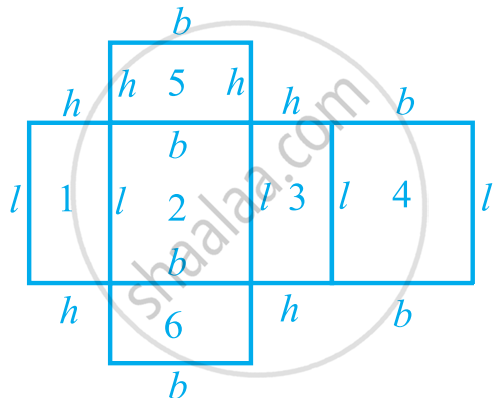
This Figure shows us that the outer surface of a cuboid is made up of six rectangles (in fact, rectangular regions, called the faces of the cuboid), whose areas can be found by multiplying the length by breadth for each of them separately and then adding the six areas together.
Let Consider h = height, b = breadth, l = length of cuboid
The total surface area of a cuboid is equal to the sum of all area of 6 rectangles.
Area of □ MNOP = Area of □ QRST = (l × b) cm2
Area of □ MRSN = Area of □ PQTO = (l × h) cm2
Area of □ MPQR = Area of □ NOTS = (b × h) cm2
Total surface area of cuboid = sum of all area of 6 rectangle = 2(l × b) + 2(b × h) + 2(l × h)
Total surface area of cuboid = 2(lb + bh + lh).
Lateral Surface area of cuboid:
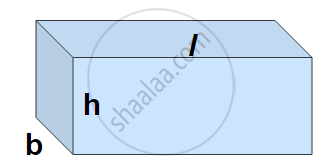
Suppose, out of the six faces of a cuboid, we only find the area of the four faces, leaving the bottom and top faces. In such a case, the area of these four faces is called the lateral surface area of the cuboid.
The lateral surface area of a cuboid is 2h(l + b), i.e., 2 × height × sum of length and breadth.
The lateral surface area of a cuboid = 2h(l + b).
Example
How much sheet metal is required to make a closed rectangular box of length 1.5 m, breadth 1.2 m, and height 1.3 m?
length of box = l = 1.5 m,
breadth = b = 1.2 m,
height = h = 1.3 m.
Surface area of box = 2 (l × b + b × h + l × h)
= 2 (1.5 × 1.2 + 1.2 × 1.3 + 1.5 × 1.3)
= 2 (1.80 + 1.56 + 1.95)
= 2 (5.31)
= 10.62 sqm
10.62 sqm of sheet metal will be needed to make the box.
